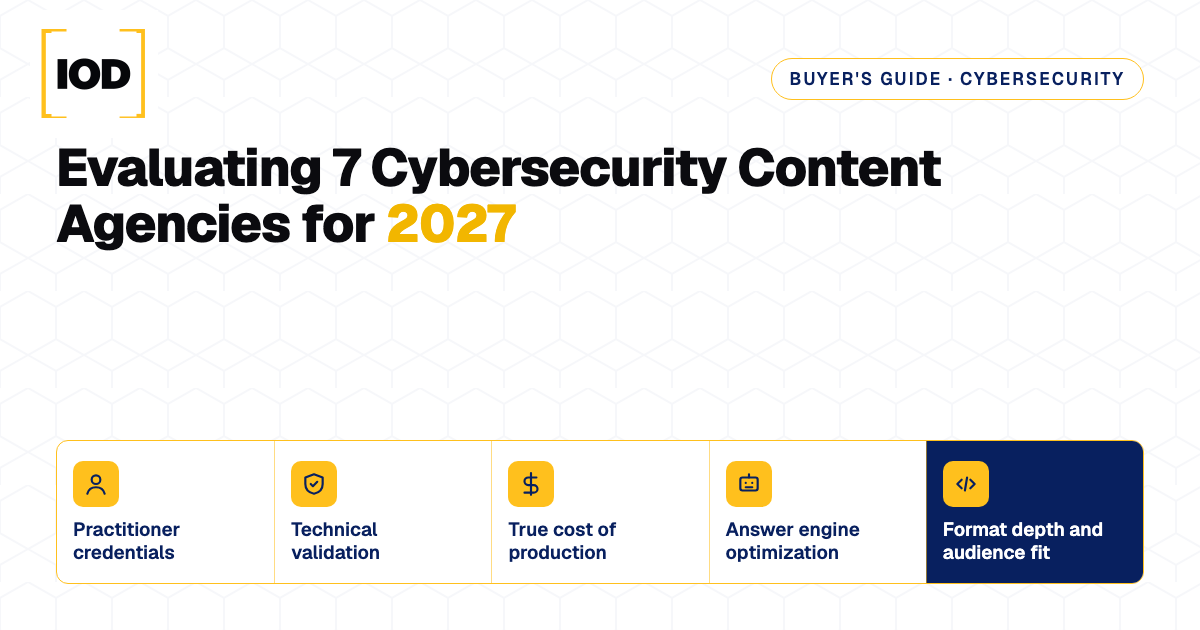
[ TL;DR ]
Key takeaways
- Practitioner credentials matter most. Writers and reviewers who have worked as SOC analysts, penetration testers, threat intelligence researchers, or security engineers are what technical security audiences trust.
- The right agency cuts hidden review work. Revision cycles never appear on the rate card, but they eat your SMEs’ and PMMs’ time.
- Every agency now claims AEO and GEO. The real question is whether it’s built into the writing with depth, or applied as a checklist that amounts to keyword stuffing for the LLM era.
- Persistent context reduces review burden. An agency that retains your positioning, product claims, and past corrections across projects needs less of your team’s time on every new piece.
Preparing your cybersecurity content strategy for 2027? Whether you’re planning the year ahead, considering replacing your current agency, or looking for a more advanced, AI-native content partner, the criteria for choosing an agency are changing. Content production is becoming more automated, but cybersecurity expertise, technical accuracy, and a deep understanding of your brand remain essential.
This guide covers five criteria for evaluating agencies against your GTM needs, then compares seven cybersecurity content agencies, including IOD, CyberEdge Group, and CyberTheory, on practitioner expertise, technical validation, content formats, AEO/GEO, and AI-native infrastructure.
Disclosure: IOD publishes this guide and is one of the seven agencies compared. Profiles of the other agencies are based on their own websites and public sources as of October 2026; where something isn’t publicly documented, we say so, and you should ask the agency directly.
Why security content demands a different kind of agency
Security buyers read by role. Three distinct groups shape how content lands:
- Practitioners (SOC analysts, detection engineers, red teamers), who test technical specificity.
- Technical decision-makers (CISOs, security architects), who evaluate vendor credibility.
- Business buyers (CMOs, VPs of marketing, demand generation managers), who read category-level content.
A single piece rarely serves all three, and an agency that can’t tell them apart produces work that serves none.
Practitioner-grade content is recognizable by what it includes: ATT&CK technique IDs, Sigma rules, detection queries, log field names, and other operational details the reader can run or verify on Monday morning.
Four signals cut through an agency’s self-description:
- Security-vertical client logos with named work.
- Format examples that show real technical density.
- Case study metrics from security programs, not general B2B SaaS.
- Writer or reviewer bios with verifiable security practitioner backgrounds.
5 criteria that separate cybersecurity content agencies from agencies that cover cybersecurity
Five criteria apply across all seven profiles, plus a bonus criterion that’s increasingly discussed at the board level:
- Practitioner credentials
- Technical validation
- True cost of production
- Answer engine optimization
- Format depth and audience fit
Practitioner credentials: who actually wrote this
The most reliable signal is the agency’s explanation of who created or reviewed the draft, and what their security background is. A polished draft proves editing, not practitioner involvement.
“Practitioner credentials” means writers who have worked as security practitioners (SOC analysts, penetration testers, threat intelligence researchers, or security engineers) or expert technical writers with equivalent knowledge of a specific security domain. The ideal writer is the target audience for the piece they’re producing.
Quality signal: practitioner-grade content uses operational terminology (ATT&CK technique IDs, CVE references, log field names, detection syntax), not category labels. Mapping capabilities to standards identifiers turns unverifiable claims into checkable ones, and those identifiers are what security buyers search for.
Diagnostic question: “Walk me through who created and reviewed this draft before it reached the client, and what their security background is. What is your quality assurance process?”
Technical validation: who reviews the draft before you do
If an agency has no credentialed security reviewer on staff or under contract, your security team and PMMs become the de facto editors, and that is the real cost of production. There are three models:
- Client-side review only: the agency delivers a draft, and your security and PMM teams handle all accuracy checks.
- Agency-side expert review: the agency flags and resolves uncertain claims internally before you see the draft.
- Hybrid: the agency flags uncertain claims, and your PMM team confirms them.
The right model is the one that matches your team’s available SME and PMM bandwidth. PMMs are among the busiest people in any GTM organization, and every draft that needs repositioning or accuracy rework is time taken from launches, messaging, and pipeline programs.
Agencies where feedback accumulates as rules across projects reduce your review burden over time. Agencies that reset context on every project recreate the same overhead each time. Ask every agency directly whether and how their AI systems handle this.
Diagnostic question: “Who reviews the draft before it reaches my team, and what is that person’s security background? Walk me through the review step. How do you keep and analyze feedback to improve future production?”
True cost of production vs. per-article rate
The per-article rate is only one part of the true cost of production. Four costs are routinely left out of a quoted rate:
- Internal SME interview time per article.
- PMM and client-side revision rounds beyond the first.
- Brief development, when the agency can’t work from a short synopsis.
- AEO/GEO coordination overhead, when optimization is a separate engagement.
Beyond the mechanics, the price you pay eventually shapes the quality you get, and the vendor’s ability to become a strategic partner. The agencies worth evaluating are the ones whose economics and AI infrastructure let them build up their understanding of your business over time, with corrections and editorial decisions that persist as rules across projects.
Answer engine optimization: built in or bolted on
AI Overviews and similar answer-engine features now appear across a growing share of searches, and they reduce organic click-through where they appear. Demand for AEO/GEO among B2B marketing leaders is rising accordingly; it has come up in nearly every content strategy conversation we’ve had in 2025 and 2026.
Every agency in this space covers AEO/GEO in some form. The differentiating question is whether optimization is built into the writing with real strategic depth, or applied as a surface-level tactic. The latter mirrors an older risk: over-indexing on optimization signals at the expense of substance is the keyword stuffing of the LLM era. Ask each agency how it balances AEO/GEO tactics with the technical credibility security audiences require, and how that shows up in a finished draft.
Format depth and audience fit
Expert-led agencies with AI infrastructure, often called AI-native content agencies, can support many content formats while keeping technical accuracy. A practitioner-reviewed article can become the foundation for social posts, video scripts, presentations, and other assets, with consistent messaging and technical claims across all of them. IOD’s long-form content approach is one example of this model.
For marketing teams, a single partner that supports content needs across GTM operations can simplify production and coordination: research, writing, white paper design, visual assets, and video production, from AI-assisted videos to professional on-site shoots. For agencies without in-house technical expertise, the challenge is keeping accuracy and depth as content is adapted into new formats, not just adding production capacity.
Bonus criterion: AI-native workflows, human review, and feedback loops
This sits outside the five main criteria because it’s still a developing capability, not yet a standard requirement. But if your CEO is asking how AI can improve efficiency while you’re worried about publishing technically incorrect AI-generated content, it’s worth asking each agency how it manages both.
Your CMO will likely have two related questions. How does the agency keep messaging consistent across marketing channels? And does it have a feedback loop that collects editorial feedback and applies it to future projects? For example, if an editor corrects a technical mistake in one article, will that correction be remembered in the next one?
The question isn’t whether an agency uses AI; most already do. It’s whether people with relevant technical expertise still lead production and review AI-assisted content. A qualified security practitioner should check technical claims before publication, so the agency gets AI’s efficiency while keeping the accuracy cybersecurity audiences expect.
Ask the agency to show you a piece created with AI assistance and explain its review process. Who checked the technical accuracy? What is their professional background? How does the feedback loop work across projects? If the agency can’t answer clearly, that raises the same concerns as the first criterion.
How the seven agencies measure up
With these criteria in mind, here’s how the seven agencies compare, based on what each one documents publicly.
IOD (iamondemand.com)
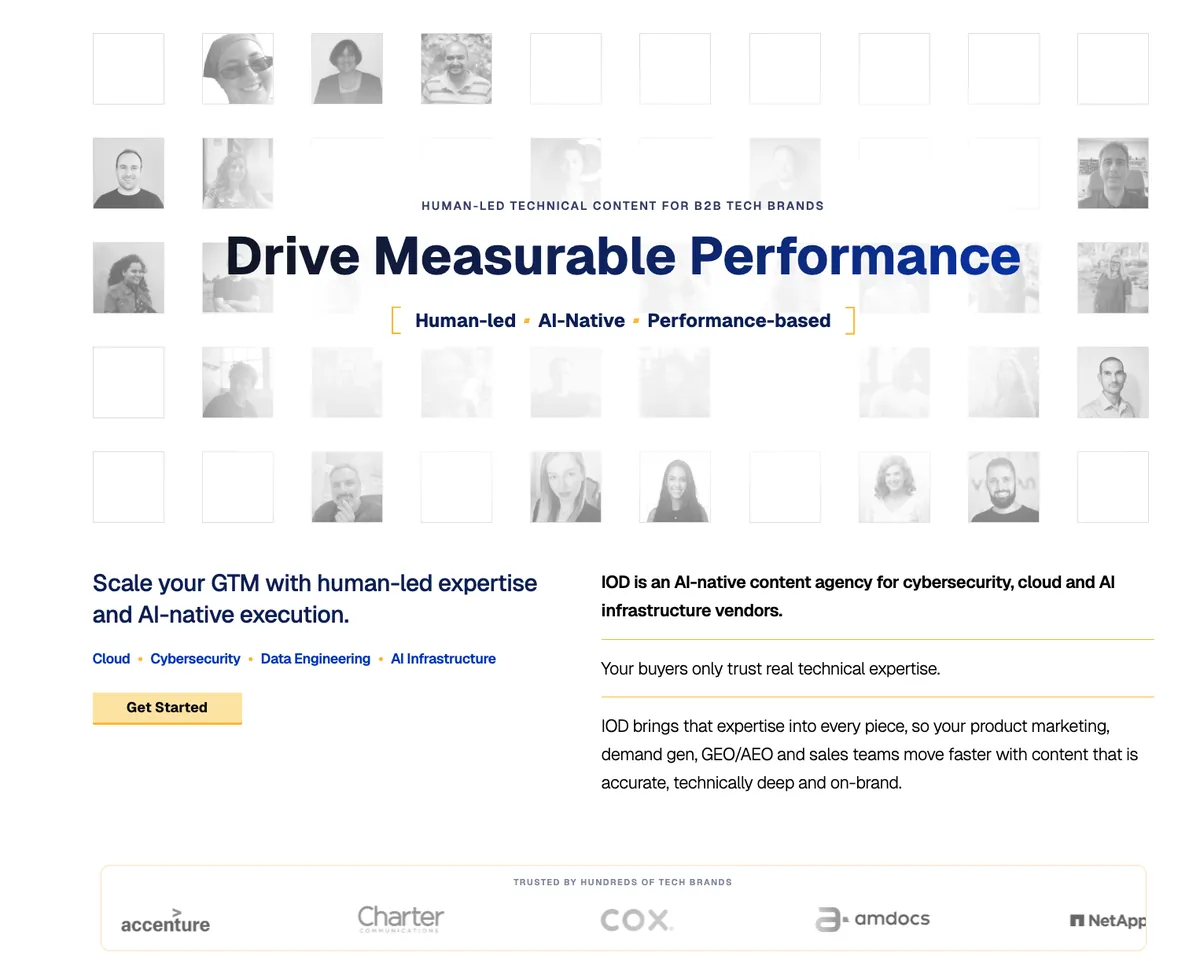
- Description: An expert-led cybersecurity content agency that has served enterprise technology brands and high-growth startups since 2017. IOD’s work spans practitioner-grade technical content for security audiences and content for enterprise decision-makers, built on a vetted network of security practitioners with CTO-level technical oversight.
- Key capabilities: Brand messaging, security thought leadership, AEO and GEO, and technical content produced with hands-on security and cloud security practitioners. This lets IOD support awareness, demand generation, sales enablement, and other GTM programs within a single long-term engagement.
- Content types: Technical articles, white papers, threat landscape reports, compliance content, graphic design, and video, with SEO and AEO/GEO built into production rather than sold as separate services.
- AI and context infrastructure: IOD is an AI-native service provider. Its proprietary platform, Stesh, retains each client’s knowledge, terminology, brand guidelines, and editorial feedback across projects, so corrections and editorial decisions persist as rules instead of resetting with each new brief.
- Track record: Work with leading cybersecurity brands such as Wiz and Check Point. For Wiz, IOD reported 18x organic traffic growth and top Google rankings for 180 security keywords within five months of starting the partnership (IOD and Wiz case study, 2024).
- Clients: Wiz, Check Point, CrowdStrike
- Pricing: Starting at approximately $5,000/month. Ask which Stesh capabilities are included in your engagement tier.
CyberEdge Group (cyberedgegroup.com)
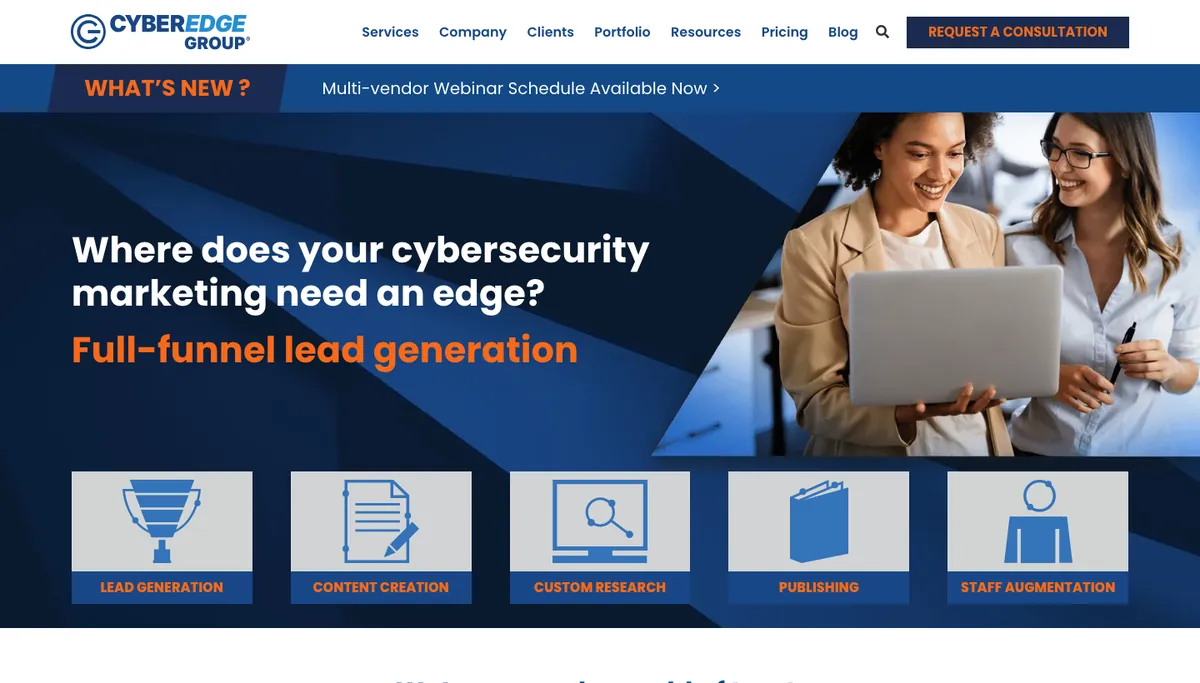
- Description: A marketing agency 100% dedicated to IT security vendors, with published testimonials from cybersecurity marketing leaders and a client portfolio.
- Key capabilities: Content production by writers and researchers it describes as cybersecurity experts, plus research sponsorship and content syndication for lead generation (under its Security Buzz brand). CyberEdge also publishes the annual Cyberthreat Defense Report (2026 edition: 1,200 IT security professionals across 17 countries and 19 industries, surveyed November–December 2025). That gives it primary research most content agencies don’t have, which can support original, data-driven content and sponsorship programs.
- Content types: Technical blogs, white papers, eBooks, research reports, media bylines, and graphic design.
- AI and context infrastructure: An AI-native production platform and the depth of its AEO/GEO integration are not publicly documented.
- Clients: Tenable, Webroot, Exostar
- Pricing: By request. CyberEdge’s 2021 pricing guide put blogs at $500 plus $500 per page (from $1,000) and white papers at $1,000 plus $1,000 per page with a four-page minimum (from $5,000). Its Marketing Bank Accounts require a $20,000 minimum deposit.
The involvement of hands-on security practitioners and a formal technical review process is not clearly documented publicly; ask about both.
CyberTheory (cybertheory.io)
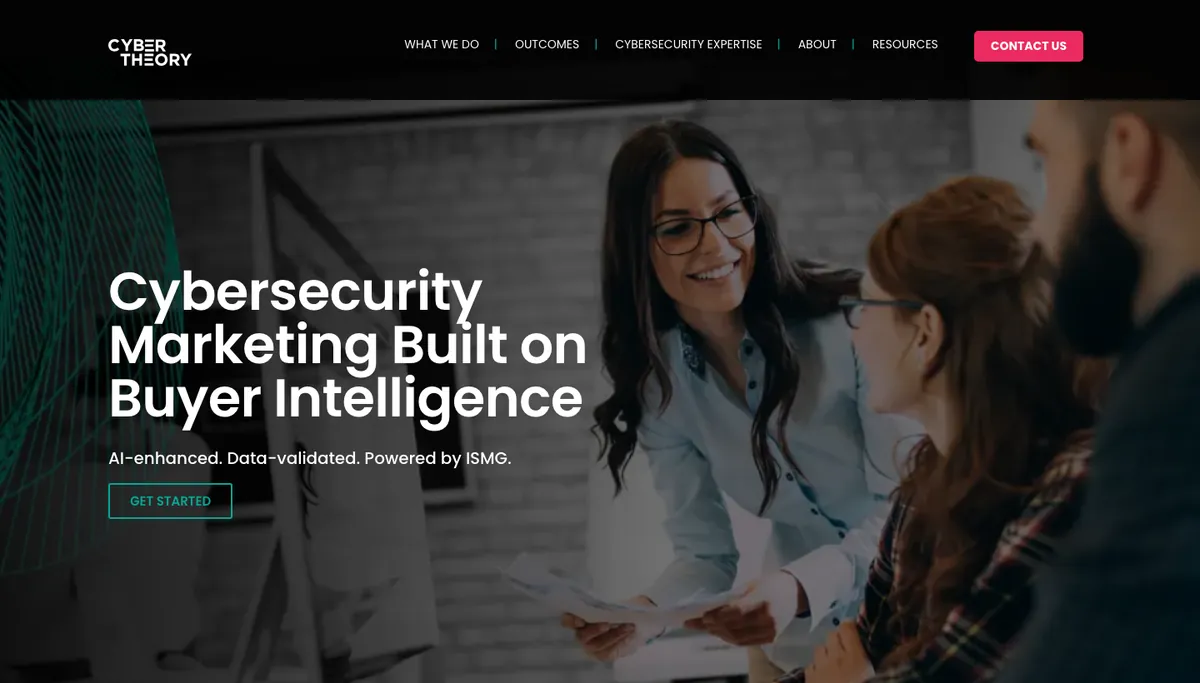
- Description: The cybersecurity marketing advisory division of Information Security Media Group (ISMG), a global cybersecurity media and research organization. Its documented work leans toward research-driven marketing and thought leadership, including an annual CISO Engagement and Decision Drivers Study published with Cyentia Institute and built on ISMG audience data.
- Key capabilities: Demand generation, SDR services, messaging and positioning, market perception research, and video sales enablement, all drawing on ISMG’s cybersecurity audience. It also offers AI search services: an AI search audit, GEO, citation strategy, and content restructuring for LLMs.
- Content types: Research studies, thought leadership, messaging, and video. How AI fits into its editorial workflow is not publicly documented.
- Practitioner credentials: There’s limited public evidence of security practitioners creating or validating deeply technical content, such as hands-on tutorials, threat analysis, or implementation guides. Validate this directly before committing.
- Best fit: If your program centers on CISO-level thought leadership, research assets, and access to ISMG’s audience, CyberTheory is worth a conversation. If practitioner-grade technical content is the core requirement, validate those capabilities explicitly.
- Clients: Its homepage shows logos including Broadcom, Palo Alto Networks, Tata, and Verizon.
- Pricing: Not publicly listed.
HackerContent (hackercontent.com)
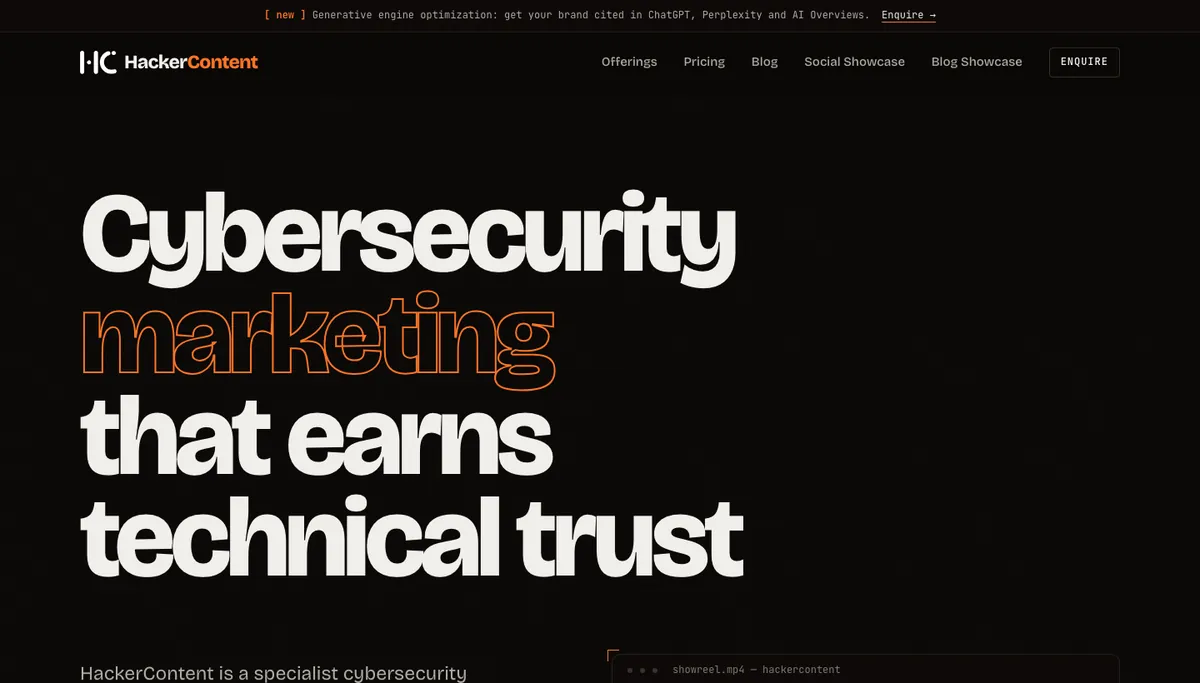
- Description: A practitioner-led cybersecurity marketing agency founded by Luke “hakluke” Stephens, a hacker and bug bounty hunter who started the penetration testing consultancy Haksec. Its team combines cybersecurity practitioners and marketers.
- Key capabilities: Cybersecurity social media management, community engagement, and technical content for security practitioners, plus technical blogs, tutorials, SEO, strategy, and developer relations. It offers GEO (getting brands cited in ChatGPT, Perplexity, and AI Overviews), and a ProjectDiscovery testimonial credits it with automating their technical content production.
- Content types: Technical blogs, tutorials, white papers, documentation, video, and social media across cybersecurity-native channels.
- AI and context infrastructure: A proprietary AI-native platform and persistent client-context infrastructure are not publicly documented. Its capacity for large enterprise programs, with multi-stakeholder workflows and formal technical QA, is also less evidenced.
- Clients: Snyk, Bugcrowd, Detectify, ProjectDiscovery
- Pricing: Social media management starts at $2,000/month for one channel, with advanced packages up to about $6,000/month. Other work is quoted per project.
Column Five (columnfivemedia.com)

- Description: A B2B content marketing and brand agency for SaaS and AI companies, not a specialized cybersecurity content agency. Its security work includes HackerOne’s “Cyberstrength” campaign: campaign strategy, messaging, visual identity, and brand video.
- Key capabilities: Brand positioning, campaign development, visual storytelling, video, and data visualization, plus content marketing for cybersecurity companies and an AEO & SEO service. Practitioner-level technical writing and validation are not documented capabilities.
- Content types: Editorial content, video, motion graphics, data visualization, interactive content, and research. A strong fit for brand and campaign work rather than practitioner-grade technical content.
- AI and context infrastructure: A proprietary AI-native production platform or practitioner validation workflow is not publicly documented.
- Clients: HackerOne, SentinelOne, Okta
- Pricing: Published on its website: a four-week Foundation Sprint at $25K, then implementation ($60K–$150K) and ongoing operation ($15K–$45K/month).
Draft.dev (draft.dev)
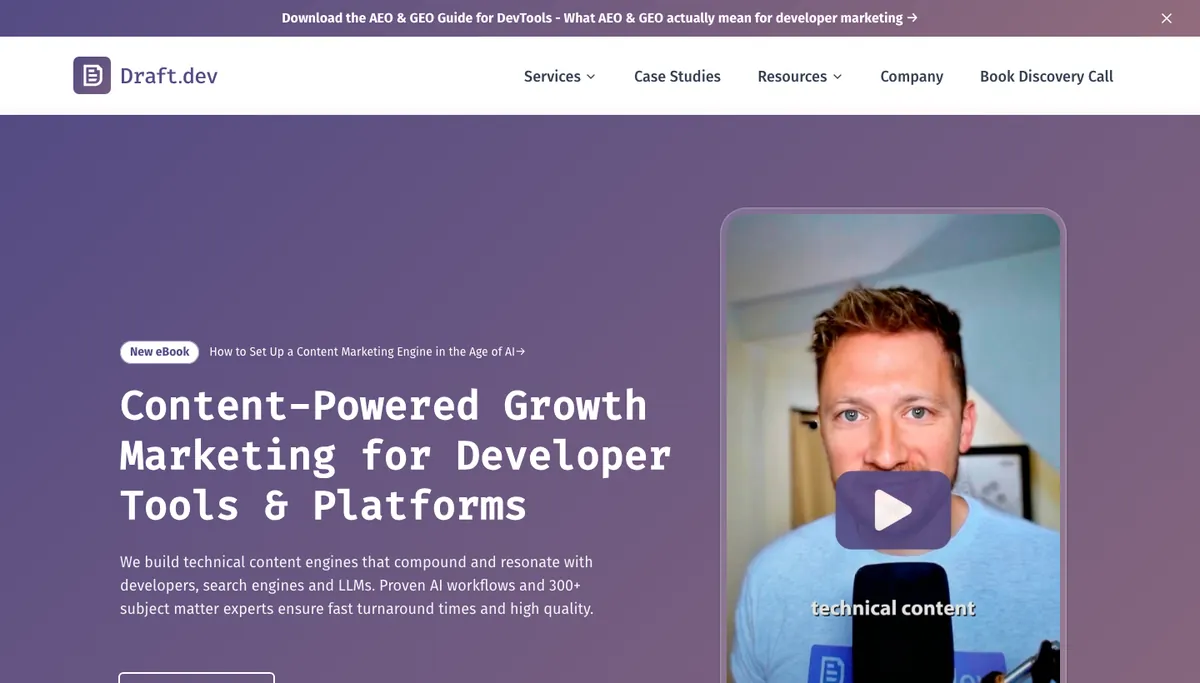
- Description: A technical content agency whose network of 300+ engineer-writers produces content for developers and other technical audiences. Its practitioner credentials are on the software engineering side, not cybersecurity-specific.
- Key capabilities: Technically accurate content produced by practicing software engineers and reviewed by subject matter experts and editors, through a structured onboarding and production process. Draft.dev also markets SEO and GEO research and AI-assisted workflows. Security-practitioner content, such as SOC analysis or threat intelligence, is less evidenced.
- Content types: Technical blog posts and tutorials, videos, comparison pages, lead magnets, and content refreshes.
- AI and context infrastructure: Uses AI workflows; a proprietary platform with persistent client context is not publicly documented.
- Clients: Docker, Cloudflare, Snyk
- Pricing: Plans start at $9K/month with a three-month minimum (published on Draft.dev’s site).
Animalz (animalz.co)
- Description: A content marketing and SEO agency for B2B SaaS brands with strong editorial credibility. Security-specific practitioner depth is not publicly documented.
- Key capabilities: Thought leadership, research reports, white papers, and content strategy, plus a dedicated AEO service (AI visibility audits, citation outreach, Reddit engagement, and AI-visibility reporting). Technical validation for security content is not publicly documented.
- Content types: Long-form content, thought leadership, research reports, white papers, and editorial strategy.
- AI and context infrastructure: Describes its work as AI-assisted and uses a proprietary AI workflow for content refreshes; persistent client-context infrastructure is not publicly documented.
- Clients: Unit21, SupportLogic, Auth0
- Pricing: Custom; no published rate card.
The seven agencies at a glance
Use this table to cross-check each agency against the criteria before you pick up the phone.
| Agency | Practitioner credentials | Technical validation | Content types | AEO/GEO integration | AI-native platform |
|---|---|---|---|---|---|
| IOD | Hands-on security practitioners and cloud architects matched to each topic | Agency-side review before delivery; feedback retained across projects in Stesh | Technical articles, white papers, threat reports, compliance content, design, video | Built into production, not a separate service | Yes: Stesh, with persistent client context |
| CyberEdge Group | Writers and researchers described as cybersecurity experts | Not publicly documented | Technical blogs, white papers, eBooks, research reports, bylines, design | Not publicly documented | Not publicly documented |
| CyberTheory | Limited public evidence for deeply technical content | Not publicly documented | Research studies, thought leadership, messaging, video sales enablement | AI search services (audit, GEO, citation strategy) | Not publicly documented |
| HackerContent | Founder and team include security practitioners | Not publicly documented | Technical blogs, tutorials, white papers, documentation, video, social | Offers GEO | Not publicly documented |
| Column Five | Not a documented capability | Not publicly documented | Brand and campaign creative, video, data visualization, editorial | Offers an AEO & SEO service | Not publicly documented |
| Draft.dev | Software engineers; security-specific credentials less evidenced | SME and editor review; security-specific QA not documented | Technical tutorials and blog posts, video, comparison pages | Markets SEO and GEO research | AI workflows; no persistent-context platform documented |
| Animalz | Not publicly documented for security | Not publicly documented | Long-form content, thought leadership, research, white papers | Dedicated AEO service | AI-assisted workflow; no persistent-context platform documented |
What to ask before you sign
These five questions help you move from reading profiles to a shortlist:
- “Walk me through who reviews a draft before it reaches my team. What is that person’s security background, and what authority do they have to send a draft back?”
- “Show me technically complex security content you’ve produced for a practitioner audience. How did you approach the technical specificity?”
- “Is AEO/GEO optimization built into what you produce, or is it a separate service? How does it show up in a finished draft?”
- “What is your onboarding process, and how does your team retain context, terminology, positioning, and past corrections between projects?”
- “If my content volume varies across the year, how does your pricing accommodate that?”
If you’re evaluating agencies for a security or cloud content program, we’re happy to walk you through how IOD approaches each of these criteria, including where we’d be the right fit and where we wouldn’t. IOD’s strategy and editorial planning is a good starting point, or explore IOD’s enterprise content services.
The agency that earns a security marketing team’s trust is the one whose process survives the first draft review intact.
[ FAQ ]
Frequently Asked Questions
What makes a cybersecurity content agency different from a general B2B content agency?
A cybersecurity content agency has writers or reviewers with hands-on security experience, so its content holds up with practitioners such as SOC analysts and detection engineers. A general B2B agency can write about security, but your own security team usually ends up correcting the technical details.
How do I verify an agency’s practitioner credentials?
Ask who created and reviewed a specific draft, and what their security background is. Look for named writers or reviewers with verifiable experience, and for samples that use operational detail such as ATT&CK technique IDs, CVE references, and detection queries.
What is the true cost of a cybersecurity content agency?
The per-article rate plus the hidden costs: your SME interview time, PMM revision rounds, brief development, and any separate AEO/GEO engagement. An agency that needs fewer review rounds can cost less overall even at a higher rate.
Should AEO and GEO be part of a content agency’s service?
Yes, but built into the writing, not applied as a checklist afterward. Ask how the agency balances AI answer-engine optimization with the technical credibility security readers expect, and how it shows up in a finished draft.
Is it a problem if a content agency uses AI?
No. Most agencies use AI. What matters is whether people with relevant security expertise lead production and check every technical claim before publication, and whether corrections are carried forward to future projects.