[ TL;DR ]
Key takeaways
- Technical expertise matters more than writing experience. Writing about cybersecurity is not the same as understanding it. Look for writers and subject-matter experts with relevant, hands-on experience in your security domain.
- Choose the production model that fits your team. Freelancers, technical content agencies, cybersecurity marketing agencies, AI platforms, and fully managed services offer different levels of expertise, support, and flexibility. The right choice depends on your goals, budget, and internal resources.
- Consider the total cost, not just the price per article. Briefing writers, reviewing technical accuracy, managing revisions, and coordinating vendors all take time. Include this internal overhead when comparing your options.
- Make sure your content production can scale. Producing two articles per month is different from managing 20 across multiple products and teams. Look for a process that maintains quality and brand consistency as production grows.
- Use AI to support expertise, not replace it. AI can accelerate research, content workflows, SEO, and GEO optimization. But credible cybersecurity content still needs expert judgment, original insights, and human validation.
I’ve spent years working with engineers and marketers, and I keep seeing the same problem across cybersecurity companies. A company can have great technology, but its content often sounds like a sales pitch that technical readers quickly lose interest in. The solution isn’t simply hiring better writers. It’s choosing the right content production approach for your company’s needs, goals, and resources.
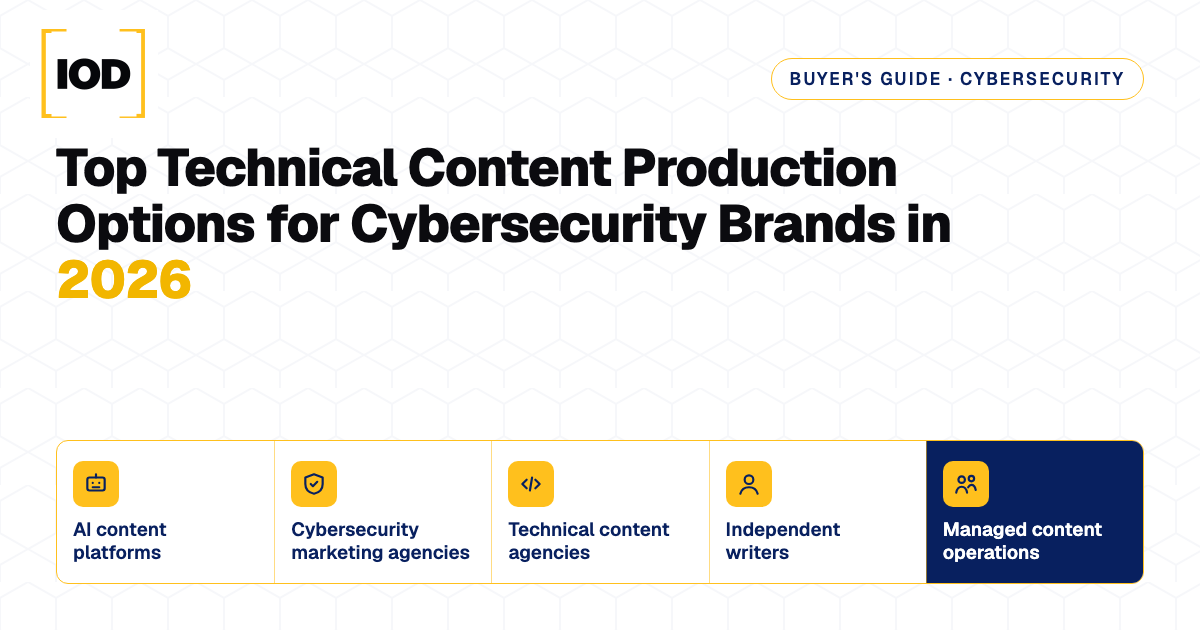
Five production categories exist: AI content platforms, cybersecurity marketing agencies, technical content agencies, independent cybersecurity writers, and Human-led, Native-AI, Managed Content Operations.
Many marketing teams choose content vendors based on writing samples and portfolio quality because it’s hard to evaluate their capabilities before working together. This guide focuses on four practical factors: technical expertise, involvement of subject-matter experts, ability to scale content production, and the time and effort your internal team will need to invest. Together, these factors help you choose the right vendor, rather than relying on a portfolio alone.
What Effective Vendor Evaluation Criteria Look Like
Writing for cybersecurity clients doesn’t necessarily mean having cybersecurity expertise. What matters is whether the vendor has access to experienced security professionals.
The three criteria that actually matter, and the fourth one most evaluations miss
- Subject-matter depth means practitioner judgment embedded in every artifact, not added as a review step at the end.
- Expert-led production means every asset is initiated, shaped, or validated by a verified security practitioner, not checked post-draft.
- Scale sustainability means the model produces consistent practitioner-depth content at weekly-program volume without degrading accuracy or compounding internal overhead. Volume that degrades accuracy over time is managed risk you haven’t measured yet.
Internal overhead is the time and effort your team spends managing a content vendor, including preparing briefs, reviewing technical accuracy, providing feedback, and coordinating revisions. These costs should be considered alongside the vendor’s fees when evaluating the total cost of content production.
Here are five options for outsourcing your content production:
| Production option | Subject-matter depth | Expert-led production | Scale sustainability | Internal overhead |
|---|---|---|---|---|
| 1 . AI content platforms | Platform-only; no domain judgment | Volume workflow; practitioner review is buyer’s responsibility | High volume; variable accuracy | Highest if no internal SME reviewer |
| 2. Cybersecurity marketing agencies | Campaign-strong; review velocity limited by platform integration | Channel and campaign expertise; expert-first platform integration varies | Strong for campaigns; review velocity depends on AI platform integration | Moderate; buyer reviews articles and manages review cycles |
| 3. Technical content agencies | Adequate for DevOps/infra overlap; domain ceiling on security-practitioner topics | Engineer-writers; not security-practitioner validators | Reliable for developer audience at scale | Moderate; security review remains buyer’s responsibility |
| 4. Independent cybersecurity writers | Practitioner-deep, one writer at a time | Authentic practitioner voice; no delivery infrastructure | Low; coordination math compounds at volume | Highest per-piece coordination burden |
| 5. Cyber Expert-based, Native-AI, Managed Content Operations | Persistent cybersecurity SME network; 100% domain-focused | Practitioner review on every artifact; platform-enforced | Sustained at weekly-program scale; intelligence compounds | Lower than managing independents; higher floor than AI platforms for low-volume programs |
With that framework in place, here’s what each category looks like in practice.
AI content platforms
AI content platforms solve volume and workflow problems but do not supply cybersecurity practitioner judgment. For teams with internal SME review capacity, they can be cost-effective. For teams without it, they convert velocity into backlog.
AirOps functions as an AI workflow and content operations platform, not a copywriting tool. It supports multi-model routing across Anthropic, OpenAI, xAI, and open-source models, alongside source injection, brand-rule enforcement, and an AirOps Content Quality Score measuring output across information gain, E-E-A-T, and SERP alignment.
Jasper is optimized for marketing execution: brand voice enforcement, campaign templates, and GEO and AI-search visibility tooling. For security and legal stakeholders, Jasper’s 90-day Audit Log tracks workspace membership and role-change events. It doesn’t record what fed a specific generation request; Jasper’s audit controls cover access governance, not prompt content. Writer takes a compliance-first architecture: the proprietary Palmyra model family, zero data retention options, and security certifications that regulated-environment procurement teams ask about first.
Publishing at volume without expert validation may create short-term visibility, but it introduces accuracy and credibility risk that compounds over time, especially when that content carries your brand’s name in a practitioner market.
Vendors in this category: AirOps, Jasper, Writer. GrowthX
Technical content agencies
Technical content agencies produce practitioner-written content with verifiable engineer-writer credentials, adequate for cloud, DevOps, and infrastructure topics overlapping with cybersecurity. Highest domain-gap risk appears on topics requiring security-practitioner judgment specifically.
Draft.dev built its reputation as the primary developer-content agency: a vetted network of engineer-writers, an editorial QA layer, and named clients including Docker and JetBrains. Cybersecurity writer recruitment has been confirmed via job postings, but no client evidence confirms security-practitioner-judgment depth for security-specific topics.
Infrasity positions toward B2B SaaS with an explicit AEO and GEO focus built into its production model. For buyers whose GEO and AEO visibility is a primary campaign objective, that bundle is worth evaluating. The open question is whether the cybersecurity subject-matter depth in the underlying content matches the AI-readiness wrapper around it. AI engines that cite technically inaccurate security content create a different category of problem than simply not ranking.
Animalz is a B2B SaaS content marketing agency known for editorial-quality thought leadership, long-form content, and SEO-driven growth, with an expanding focus on AEO and AI-assisted workflows. Unlike developer-focused agencies such as Draft.dev, Animalz emphasizes content strategy and storytelling over practitioner-authored technical depth, making security-specific expertise and validation by qualified cybersecurity SMEs important considerations for buyers.
The domain-gap line matters here. Cloud configuration, container security basics, and secure DevOps practices fall within what a strong engineer-writer handles. Threat modeling, incident response, compliance-specific claims (NIS2, SOC 2 gap analysis), and CISO-audience thought leadership carry the highest domain-gap risk. The concrete scenario: a developer-content agency takes an AppSec pipeline brief. The draft reads correctly to a developer audience but contains a characterization of SAST versus DAST integration sequencing that a security architect would flag as backwards. The developer writer didn’t know enough to know it was wrong. “Reads correctly to a developer” is not the same as “accurate for a security-practitioner audience.”
Vendors in this category: Draft.dev, Infrasity, Animalz.
Cybersecurity marketing agencies
Cybersecurity marketing agencies are optimized for campaign integration, media relationships, and audience reach. Most have technically oriented writers or can source them. Their structural limitation is not raw writing depth; it’s the absence of an AI platform that integrates GenAI with human experts in a way that accelerates production and specifically compresses the review cycle.
Some agencies in this space are built around research syndication and lead generation, with flagship research reports and veteran consultants supporting campaign delivery. Others focus on buyer research reports and content syndication campaigns tied to measurable pipeline outcomes.
HackerContent is a cybersecurity-focused content marketing agency founded by penetration tester Luke Stephens. Its services include technical content production, SEO, social media, and video marketing, with clients including Snyk, Bugcrowd, Detectify, and ProjectDiscovery.
CyberEdge Group provides cybersecurity marketing services covering content creation, market research, competitive intelligence, white papers, and demand generation. The company also publishes the annual Cyberthreat Defense Report, using industry research to support content development and marketing programs.
CyberTheory is a cybersecurity marketing advisory firm offering positioning, content strategy, demand generation, account-based marketing, and sales enablement. Its relationship with ISMG supports access to cybersecurity audiences, industry research, and media distribution channels.
Column Five is a B2B content marketing agency serving technology and SaaS companies, with services spanning content strategy, brand messaging, visual storytelling, SEO, and multimedia production. Its work includes white papers, infographics, reports, and other marketing assets. Unlike the cybersecurity-specialist agencies, Column Five serves multiple industries, so technical cybersecurity expertise may depend on the specific team and subject-matter experts involved.
AI made drafting faster, but most cybersecurity marketing teams are still waiting on the same review chains they had two years ago. That’s the structural limitation. The bottleneck isn’t that agencies can’t find writers. It’s that their production and approval chains haven’t been rebuilt around a GenAI-plus-human workflow that reduces the time from brief to published.
Here’s the scenario: your team briefs a cybersecurity agency on a Non-Human Identity (NHI) security topic that’s trending across practitioner channels. The white paper process runs its normal course. By the time the draft clears review and revisions, NHI has cycled out of the conversation and three competitors have published practitioner-grade content on it. The agency delivered a technically sound piece. It just arrived too late to matter.
Vendors in this category: HackerContent, CyberEdge Group, CyberTheory, Column Five.
Bonus option: Independent cybersecurity writers
Independent cybersecurity writers, such as Jody Williams, Vina Nguyen, and Bruce Sussman, offer different types of experience in technical writing, cybersecurity, and industry communications. Working directly with experienced writers can help companies produce more informed, credible content, particularly for technical white papers, thought leadership, and articles aimed at CISOs and security professionals. Over time, a regular writer can also become familiar with the company’s products, messaging, and audience.
The main challenge is managing the work. Freelance writers still need briefs, editorial reviews, feedback, and coordination. This is relatively straightforward for a few articles per month but becomes harder as content volume grows or multiple writers are involved. Companies also need to check each writer’s technical background, since experience writing about cybersecurity does not always mean hands-on security expertise.
Human-led, Native-AI, Managed Content Operations
Human-led, Native-AI, Managed Content Operations is not an evolved agency model. It is what people now call “Services as Software” or modern managed services: human-led, expert-first services supported by a proprietary AI platform, with all three components designed together from the start.
In IOD’s case, those three components are: managed execution (project management and editorial operations), expert-first production (a network 100% focused on cybersecurity, not a general tech firm with a cyber practice added), and Stesh, IOD’s proprietary intelligence platform (a persistent brand and technical context layer that accumulates across every project rather than resetting between engagements).
Outcomes from named engagements: in one year, Wiz CloudSec Academy grew from 500 to 30,000+ monthly organic sessions and reached 1,400 top-3 Google keyword rankings across its Learning Center content. These are specific case outcomes, not typical results. Raaz Herzberg, CMO and VP Product Strategy at Wiz, describes the pipeline result:
“…if you look at how much we’ve spent on IOD content so far, the amount of attributed pipeline from the Academy is outpacing that. So the content has been more than paying for itself from early on in our engagement.”
Raaz Herzberg, CMO and VP Product Strategy, Wiz
How to evaluate any of these options before you sign anything
Before you commit, run a structured evaluation. Here’s how I’d do it:
- Commission a paid test piece. Ask for a sample article on a specific, technically nuanced topic, not a generic overview. Pay for it. Free samples tend to be cherry-picked; paid ones reveal the actual process.
- Have a cybersecurity practitioner red-line it. Don’t evaluate accuracy yourself unless you’re a practitioner. Get someone who is to mark every claim that’s wrong, vague, or shallow. The density of red lines tells you more than any sales call.
- Ask structural questions about SME involvement. Who wrote this draft? Who reviewed it for accuracy? Was that person a working security practitioner or an editor with a cybersecurity background? The distinction matters.
- Request a sample editorial brief or workflow document. A vendor who can show you how a piece moves from topic to published asset, including who touches it and when, understands production. A vendor who can’t explain the process probably doesn’t have one worth trusting.
- Ask what happens when something is wrong. How are errors caught before publish? What’s the correction process after? The answer reveals whether accuracy is a built-in constraint or an afterthought.
- Ask for evidence of actual results. Credibility and experience matter, but so does proof. A vendor worth trusting can show you traffic outcomes from content they’ve produced, LLM visibility performance for their clients’ topics, or lead generation tied to specific content programs. If they can’t point to results, they’re selling process, not outcomes.
[ FAQ ]
Frequently Asked Questions
How much internal review time should I budget for each content production option?
The range runs from minimal (Human-led, Native-AI, Managed Content Operations handles accuracy review internally) to two to four hours per piece for independent writers and most agency-produced content, covering briefing, review, and revision coordination. AI platforms require the most variable overhead: a practitioner accuracy review adds the same time as reviewing any other draft, regardless of how fast the platform generated it.
Can a cybersecurity marketing agency and an AI content platform work together in the same program?
Yes, and many agencies already use AI platforms internally for drafting. The evaluation question doesn’t change: who specifically provides the practitioner review before anything ships, and is that review embedded in the workflow or bolted on at the end?
At what content volume does the independent writer model stop making sense?
Most teams find the model becomes operationally unsustainable at four to six pieces per month across multiple writers. At that point, time spent managing the roster approaches or exceeds what it would take to manage a structured engagement with another category.
What’s the biggest mistake buyers make when evaluating these options?
Most buyers compare price per piece without accounting for internal overhead: the briefing time, review rounds, and revision coordination each model demands. The real cost of a cheaper option often shows up in the hours your team spends making it work.
How do I know if my team has enough internal SME capacity to use an AI content platform effectively?
If you have at least one cybersecurity practitioner who can review every draft for technical accuracy before it ships, an AI platform can work for volume content. Without that internal reviewer, the platform accelerates output but doesn’t protect credibility.
Should a startup with a small marketing team choose a different option than an enterprise security vendor?
The right choice depends less on company size than on how much internal editorial and SME capacity you have available. A startup with an engaged technical co-founder can succeed with independent writers; an enterprise with no internal cyber expertise will struggle with any option that assumes that knowledge is already in-house.
Is subject-matter depth verifiable before I sign a contract?
Ask for writing samples on topics close to your own product area, and then have a practitioner on your team assess whether the technical claims hold up. A vendor who can’t supply relevant samples or resists that review step is giving you an answer before you’ve asked the question.