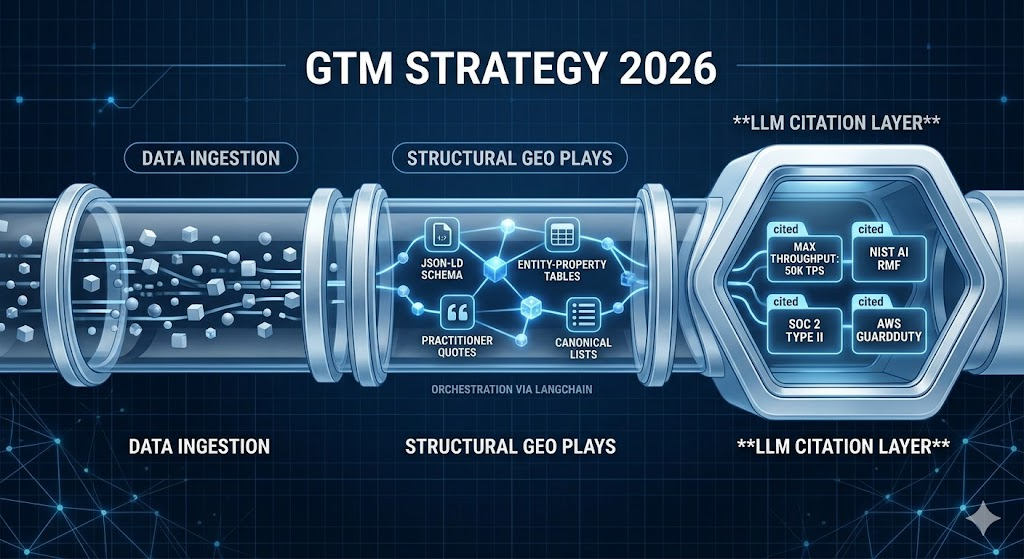
Key Insights
- Bridge the entity gap: AI models index authority through specific tools, systems, and frameworks (e.g., AWS GuardDuty, SOC 2 Type II, or NIST CSF 2.0) rather than generic keywords (“cloud security services,” “compliance requirements,” or “security frameworks”). Map your product to the real-world tools your buyers use to ensure you are cited as a primary source.
Example: Swap “How to Secure Your Data” for “Configuring AES-256 Encryption in AWS S3.”
- Bridge the entity gap: AI models index authority through specific tools, systems, and frameworks (e.g., AWS GuardDuty, SOC 2 Type II, or NIST CSF 2.0) rather than generic keywords (“cloud security services,” “compliance requirements,” or “security frameworks”). Map your product to the real-world tools your buyers use to ensure you are cited as a primary source.
- Enable data-rich extraction: LLMs prioritize content that is easy to parse into verifiable data points. Format technical specs into “entity-property” tables to guarantee AI agents lift your exact product limits as direct quotes.
Example: Use a table mapping “Max Throughput: 50k TPS” instead of writing “Our tool is highly scalable.”
- Enable data-rich extraction: LLMs prioritize content that is easy to parse into verifiable data points. Format technical specs into “entity-property” tables to guarantee AI agents lift your exact product limits as direct quotes.
- Eliminate information latency: GTM stalls when marketing lags behind engineering. AI agents cross-reference your documentation against global release cycles; outdated dependencies flag your content as a legacy risk. Sync your assets with every release to ensure your technical specs match the current ecosystem and secure citation.
Example: If your content still references Python 3.8 (EOL) or Kubernetes 1.24 while the industry has moved to Python 3.13 and Kubernetes 1.30, the AI flags your solution as a technical debt risk and stops recommending your tool for modern deployments.
- Eliminate information latency: GTM stalls when marketing lags behind engineering. AI agents cross-reference your documentation against global release cycles; outdated dependencies flag your content as a legacy risk. Sync your assets with every release to ensure your technical specs match the current ecosystem and secure citation.
- Master query fan-out logic: AI agents decompose a single prompt into 8–12 parallel sub-queries to verify facts. Provide deep, interconnected technical evidence to secure your place across the entire retrieval chain.
Example: When a user asks “Is Product X secure?”, the AI secretly fans out to sub-queries like “Does Product X support AES-256?”, “Is Product X SOC 2 compliant?” If you lack these specific data points, the AI pulls the answers from a competitor’s documentation instead.
- Master query fan-out logic: AI agents decompose a single prompt into 8–12 parallel sub-queries to verify facts. Provide deep, interconnected technical evidence to secure your place across the entire retrieval chain.
My career started in a very different world. I worked with researchers reporting from conflict zones, attended conferences with diplomats, and collaborated with academic publishers like Yale University Press and Routledge.
Back then, “keywords” were just metadata for a library catalog: a way to file a document so a fellow researcher could find it in a static database.
But then I pivoted. I became a content marketing manager at an SEO agency, managing content for fast-moving tech startups. Suddenly, keywords weren’t just labels; they were a competitive currency. I had to learn how to optimize for Google algorithms and product links to prove ROI in a crowded market.
As AI search started to gain traction, as head of editorial and content marketing at IOD, I had to quickly rethink everything we knew about discoverability to ensure we were delivering value to the leading tech brands we serve.
Today, on client calls, I rarely hear “What’s GEO?” anymore. AI discovery is now a normalized part of the B2B buyer journey, and most marketers are already trying to implement it.
The problem I see now is fragmented execution. Teams are adding FAQs or summaries, but their content still isn’t being cited by LLMs. They have the awareness, but they lack the structural rigor to bridge the “entity gap” required to move from being summarized to being cited in a market that has already matured.
To move from “searchable” to “citable,” your content must bridge the gap between abstract marketing and technical reality.
What Is the Entity Gap?
The entity gap is the disconnect between the generic terms marketers often use and the specific, real-world systems that LLMs use to index authority.
While traditional SEO relies on matching keyword strings, modern AI search engines rely on relationship extraction. As Microsoft’s 2026 GraphRAG framework notes, baseline AI retrieval often “struggles to connect the dots” when information is abstract or disparate.
If your content stays at the level of “cloud security best practices” instead of naming specific tools like AWS GuardDuty, or refers to “efficient container orchestration” instead of detailing Kubernetes 1.30 resource limits, you aren’t giving the AI the “dots” it needs to build those connections.
Bridging this gap is the difference between being vaguely summarized and being cited as a primary source.
AI search isn’t replacing traditional SEO; it’s changing what it means to be authoritative. In 2026, if your content stays abstract, LLMs won’t be able to map your expertise to the real-world systems your buyers use. To move from being summarized to being cited, you need to change how you structure your editorial workflow.
Implement GEO Frameworks: 8 Technical Wins for AI Visibility
Bridge the entity gap and increase your brand’s citation rate with these eight structural adjustments. These actions optimize your content for extraction across both legacy engines (Google, Bing) and agentic platforms (ChatGPT, Perplexity, Gemini).
For a deeper dive into foundational frameworks, see The Tech Marketer’s Guide to Generative Engine Optimization (GEO).
1. Structure for Extraction: The IOD “High-Density” Anchor
In 2026, LLMs don’t “read” your blog; they ingest it as a data source. If your technical conclusion is buried in “fluff,” the AI is forced to summarize. And that’s where brand nuance dies. At IOD, we convert traditional prose into high-density anchors, fixed structural points that force the AI to cite your exact technical specs.
The Action: Lead with “Answer-First” Chunks
Instead of the traditional “Introduction → Body → Conclusion” flow, at IOD, we use a modular structure. This ensures the most citable information is at the top, formatted specifically for the “scrapers” and “agents” that power conversational search.
- The TL;DR Summary Block: We place a 2–3 sentence “Key Insights” block immediately under the H1. This isn’t a teaser; it is the complete answer to the user’s primary query. By providing the answer upfront, you create a “semantic signature” that AI agents can lift as a direct quote, ensuring they use your technical phrasing instead of a generic AI summary.
- The “Entity-Property” Table: Whenever you compare tools or list specs, use a table. For example, instead of describing AWS GuardDuty’s features in a list, use a table that maps Entities (the tool) to Properties (max throughput, latency, cost). According to GraphRAG benchmarks, LLMs index structured tables with 40% higher retrieval accuracy than bulleted lists.
- The “Entity-Property” Table: Whenever you compare tools or list specs, use a table. For example, instead of describing AWS GuardDuty’s features in a list, use a table that maps Entities (the tool) to Properties (max throughput, latency, cost). According to GraphRAG benchmarks, LLMs index structured tables with 40% higher retrieval accuracy than bulleted lists.
Element | Legacy SEO (Invisible) | The IOD Standard (Citable) |
Summaries | “In this post, we will explore…” | “TL;DR: Use X to solve Y.” |
Technical Specs | “Our tool is highly scalable…” | “Max Throughput: 50k TPS” (structured table) |
Advanced tip: Use AI visibility tools to check if your TL;DR is actually being “lifted” by agents. If Perplexity or Gemini isn’t quoting your summary block within 48 hours, your “information density” is too low, and the AI is still “guessing” your intent.
2. Define the Machine-Readable Layer
In 2026, AI engines use JSON-LD schema (the background code that tells an LLM exactly what a page is about) to classify and prioritize your data nodes. If your content isn’t structured to support these “tags,” the AI is forced to guess, increasing the risk of being ignored or misinterpreted. At IOD, we draft content specifically to trigger these high-value technical labels.
The Action: Structural Signals for Implementation
- Main Subject Mapping (about): We identify the primary technical entity (e.g., AWS GuardDuty) so your team can tag the asset as a definitive authority.
- Conversational Answer Logic (acceptedAnswer): We draft FAQ blocks as modular “Answer Chunks” designed to be lifted as direct quotes by AI agents.
- Functional Sequences (step-by-step): We structure technical tutorials so they can be parsed as executable logic for AI agents.
- Functional Sequences (step-by-step): We structure technical tutorials so they can be parsed as executable logic for AI agents.
Content Element | Human-Facing Format | Client Implementation (GEO Signal) |
Primary Topic | High-authority blog post | about: [Specific Entity] |
Expert Q&A | Modular FAQ sections | acceptedAnswer (direct quote) |
Technical Guide | Numbered Tutorial | step-by-step (agentic logic) |
Advanced tip: Monitor your AI inclusion rates. If your guides aren’t appearing as “Solution Steps” in ChatGPT or Gemini, your schema tags are likely too generic. Adopt specific types like SoftwareSourceCode or TechnicalArticle to ensure AI agents prioritize your technical data nodes over general blog content.
3. Optimize Headings for Entities, Not Just Keywords
In 2026, LLMs organize knowledge by entities (products, platforms, standards) rather than just search strings. Headings that explicitly reference known entities like AWS, SOC 2, or ISO 27001 outperform generic headers because they align with how AI retrievers pull answers for specific technical queries.
The Action: Transition to Entity-Based Headings
Stop writing for “search volume” and start writing for data mapping. Use H2 and H3 tags to anchor your brand to the specific technical ecosystem your buyers are searching for.
- Close the Entity Gap: Use headings that link your solution to a recognized platform or regulation. Instead of “Cloud Security Tips,” use “Orchestrating CSPM Guardrails via Terraform.”
- Establish a Canonical List: Identify the 10 to 15 platforms, services, and regulations that are “must-haves” for your niche. Ensure your headings consistently map your expertise to these named entities to be considered an authoritative source by the LLM.
- Establish a Canonical List: Identify the 10 to 15 platforms, services, and regulations that are “must-haves” for your niche. Ensure your headings consistently map your expertise to these named entities to be considered an authoritative source by the LLM.
Legacy SEO Heading (Old Style) | Entity-Based GEO Heading (New Style) |
How to Pass a SOC 2 Audit | Mapping SOC 2 Trust Services Criteria to AWS Config Rules |
Zero Trust Architecture Benefits | Implementing Identity-Based Microsegmentation via SPIFFE/SPIRE |
Best Fintech Payment APIs | Integrating Stripe Connect with ISO 20022 Standards |
Cloud Security Risk Management | Correlating FAIR Quantitative Analysis with SIEM Telemetry |
Guide to PCI DSS Compliance | Validating Point-to-Point Encryption Across Merchant POS |
Mobile App Security Features | Hardening Biometric Auth via Secure Enclave API Calls |
Cloud Security Best Practices | Orchestrating CSPM Guardrails through Terraform Sentinel |
Advanced tip: Periodically run NLP audits to scan your site against competitors. If industry leaders are ranking for specific entities (like a new NIST framework) that you aren’t mentioning in your headings, the AI will view your content as “incomplete.”
4. Integrate Attributed Practitioner/SME Quotes in Context
AI engines prioritize lived experience over generic descriptions. By including named technical experts, you provide the high-authority signals that LLMs require. At IOD, we ensure every SME quote is mapped to NIST’s Trustworthy AI characteristics, transforming a simple testimonial into a verifiable signal of institutional reliability.
The Action: Anchor Content in Subject Matter Expertise
Stop relying on a generic “corporate” voice. Feature the internal and external experts who actually build and secure the tech you are writing about.
- Boost EEAT via Attribution: Every technical claim should be supported by a named SME. This provides the experience and expertise markers that LLMs use to verify the authority of your data.
- Feature Real Perspectives: Use named SMEs and real customer perspectives to address specific technical edge cases. This makes your content unique and much harder for an AI to replicate.
- Feature Real Perspectives: Use named SMEs and real customer perspectives to address specific technical edge cases. This makes your content unique and much harder for an AI to replicate.
Content Element | Legacy SEO (Low-Trust) | The IOD Standard (GEO) |
Primary Voice | Corporate / third-person | Named practitioner / SME |
Technical Logic | Generic “best practices” | Real-world edge cases & solutions |
AI Citation Signal | “Common knowledge” (no citation) | “Authoritative expertise” (high citation) |
Advanced Tip: Maintain a structured library of SME soundbites tagged by topic for agile reuse. This allows your team to rapidly inject verified human authority into every asset, ensuring your brand remains a cited leader in AI-driven search results.
5. Build and Maintain Strategic Internal Link Ecosystems
Strategic internal links across related assets help AI models understand topical depth and relationships. This increases the likelihood that multiple pages from your site will be surfaced together as a cohesive content cluster.
The Action: Establish Topical Authority via Robust Crosslinking
Stop treating links as simple navigation. Use them to signal the breadth and depth of your technical expertise to AI models.
- Strengthen Topical Clusters: Regularly review and strengthen links from top-performing “pillar” URLs to deep-dive technical assets and product pages.
- Surface Related Insights: Ensure that high-authority pages link directly to your latest research and documentation, preventing your newest insights from becoming “orphaned” or invisible to LLM retrievers.
- Surface Related Insights: Ensure that high-authority pages link directly to your latest research and documentation, preventing your newest insights from becoming “orphaned” or invisible to LLM retrievers.
Linking Strategy | Legacy SEO (UX-Only) | The IOD Standard (GEO) |
Structure | Scattered / manual | Intentional / cluster-based |
Purpose | User navigation | Contextual logic for AI |
AI Signal | Shallow / Isolated data | Topical authority / deep graph |
Advanced Tip: Use heatmaps and AI-driven link analytics to identify and fix gaps. If your most authoritative pages aren’t feeding your new technical guides, the AI will struggle to “trust” the newer content as part of your core expertise.
6. Systematically Refresh and Timestamp Your Top Content
Regularly updating and timestamping content signals freshness to AI-powered search systems. In fast-moving domains like GenAI, cloud, and security, LLMs prioritize recent information to ensure the accuracy of the answers they generate.
The Action: Maintain Content Recency in Volatile Verticals
When assembling answers from multiple sources, next-gen search engines prioritize fresh content. Even a highly authoritative guide can lose its ranking if the AI perceives the data as “stale.”
- Schedule Quarterly Micro-Updates: Don’t wait for a full rewrite. Add new stats, recent event insights, or fresh practitioner quotes to maintain your “freshness” score.
- Refresh Technical Timestamps: Ensure your metadata reflects the most recent review. This simple signal tells the LLM that your technical specs are current for the 2026 landscape.
- Refresh Technical Timestamps: Ensure your metadata reflects the most recent review. This simple signal tells the LLM that your technical specs are current for the 2026 landscape.
Update Strategy | Legacy SEO (Static) | The IOD Standard (GEO) |
Frequency | Annual / reactive | Quarterly / scheduled |
Scope | Major rewrites only | Targeted micro-updates |
AI Signal | Potential “legacy” risk | High-recency authority |
Advanced Tip: Use AI-driven change detection tools (e.g., MarketMuse, ContentKing, or Clearscope) to track when a topic’s search landscape has shifted. This allows for “just-in-time” updates, ensuring you refresh your content exactly when the LLM’s baseline knowledge begins to evolve.
7. Audit and Optimize AI Visibility with Dedicated Tools
Specialized LLM visibility tools (e.g., Spotlight, Visibility.ai) show exactly how your content appears across ChatGPT, Gemini, and Perplexity. This allows for data-driven improvements based on how LLMs actually retrieve and summarize your technical data.
The Action: Automate AI Surface-Area Audits
Stop guessing if your content is being read by AI agents. Use dedicated platforms to benchmark your “share of voice” within conversational search results.
- Benchmark Against Competitors: Run monthly visibility reports to see which brands the LLM cites as the “authoritative source” for your core technical entities.
- Identify Retrieval Gaps: Flag high-value assets that are being missed or misinterpreted by AI. Route these findings to your editorial team to adjust the “information density” or schema of those specific pages.
- Identify Retrieval Gaps: Flag high-value assets that are being missed or misinterpreted by AI. Route these findings to your editorial team to adjust the “information density” or schema of those specific pages.
Audit Type | Legacy SEO (Rankings) | The IOD Standard (GEO) |
Data Source | Search Console / keyword position | LLM citation / attribution rate |
Metric | Blue link clicks | Presence in conversational answers |
Output | Keyword optimization | Entity & citation optimization |
Advanced Tip: Use visibility findings to fix retrieval errors. If an LLM is “hallucinating” your product limits or missing a key feature, a targeted update to your SoftwareApplication schema or a clearer TL;DR summary can often fix the error within 48 hours. This turns your audit from a passive report into an active correction of your brand’s AI footprint.
8. Transition from “Searchable” to “Actionable” Content
By 2026, baseline optimizations like schema and summary blocks are standard technical requirements. High-growth tech brands are now moving toward agentic engineering: ensuring content isn’t just summarized by an AI, but used by an agent to execute a task or make a final “build vs. buy” recommendation.
The Action: Prioritize Inference Accuracy and Agentic Logic
Stop writing for “readability” alone and start writing for functional retrieval. Structure your data so AI agents can pull out precise facts (like your exact product limits or compliance specs) without having to guess your meaning.
- Master Vector Space Mapping: Analyze “query fan-out” to understand the 3–5 sub-queries an AI runs after a user’s initial prompt. Your content must satisfy the entire logical chain to remain the primary source of truth.
- Reduce AI Retrieval Time: If your data is buried in complex PDFs or slow-loading code, AI agents may “time out” and skip your site. Consider providing a clean, text-only “fast lane” (like an ai.yourbrand.com subdomain) that allows AI bots to find and cite your specs in milliseconds.
- Reduce AI Retrieval Time: If your data is buried in complex PDFs or slow-loading code, AI agents may “time out” and skip your site. Consider providing a clean, text-only “fast lane” (like an ai.yourbrand.com subdomain) that allows AI bots to find and cite your specs in milliseconds.
Strategy Level | Foundational GEO | Advanced GEO (2026) |
Data Goal | Gaining a citation | Becoming the “system prompt” source |
Logic | Summarization-ready | Execution-ready (agent-actionable) |
Measurement | Mention frequency | Inference accuracy & pipeline attribution |
Advanced Tip: Use “compound AI system” audits. Don’t just check if you’re appearing in Perplexity; test how your content performs when fed into a Claude Project or a GPT-5.x Custom Agent tasked with a complex technical analysis.
Scaling Your Influence in the Agentic Era
In 2026, technical authority is a baseline requirement for GTM success. Shifting from keyword matching to entity-based influence ensures your expertise remains the primary source for the agents driving the B2B buyer journey. By prioritizing precision and practitioner-led insights, you evolve your presence from a static resource into an actionable knowledge node for the agentic era.
Select two strategies from this guide and apply them to your highest-impact technical assets this quarter. Measure the change in your citation rates to build a data-backed case for scaling these efforts across your entire GTM strategy.
Is your GTM invisible to AI? Secure your place in the citation layer. Get your product reality to market faster. Talk to us.
FAQ
What is the primary difference between SEO and GEO for technical content?
While traditional SEO focuses on matching keyword strings for human searchers, generative engine optimization (GEO) focuses on relationship extraction for AI models. SEO aims for a “blue link” click; GEO aims for a direct citation within an LLM’s conversational response by providing structured, entity-linked data.
How do I improve my brand’s citation rate in ChatGPT or Perplexity?
To increase your citation rate, move from abstract marketing language to entity-property mapping. Structure your technical specs (like throughput, latency, and compliance standards) into Markdown tables and use JSON-LD schema to explicitly link your content to recognized platforms like AWS, Azure, or NIST.
Why are my technical guides being summarized by AI instead of cited as a source?
AI agents summarize content when the information density is too low or the structure is too narrative. To force a citation, implement a “TL;DR” summary block at the top of your page and use step-by-step schema logic. This signals to the LLM that your content is an authoritative sequence rather than a general discussion.
What are “Entities” in the context of AI search?
Entities are the unique, verifiable “nodes” in an AI’s knowledge graph, such as Terraform, Kubernetes, or SOC 2. By anchoring your headings and metadata to these specific entities instead of generic keywords, you help the LLM categorize your brand as a primary authority within that specific technical ecosystem.
How often should I refresh technical content to maintain AI visibility?
In volatile technical sectors, you should execute quarterly micro-updates. AI agents cross-reference your documentation against global release cycles; updating your dateModified timestamps and verifying compatibility with current versions (e.g., Python 3.13) prevents the AI from flagging your content as a “legacy risk.”