[ TL;DR ]
Key takeaways
- Verify technical depth; don’t take it on faith. Most agency relationships break down in the gap between sounding credible in a pitch and surviving your product marketing team’s review.
- AI governance is a credibility issue. Security architects spot AI-introduced errors, such as invented CVEs and wrong compliance claims, and the pattern is documented.
- Expert writers should make your team sharper. The best agencies don’t just add capacity; their writers bring knowledge that makes your marketing team more credible in technical conversations.
- Look for an agency where accuracy compounds. Agencies that carry context forward from brief to brief work very differently from those that start fresh every time.
I recently spoke with an agency providing SEO and GEO services to a cybersecurity startup, around three years old and based in Israel. When I asked about performance, they couldn’t show traffic growth or visibility trends. Instead, they proudly explained that they automatically generate and publish AI content at scale, without human review, directly under the founder’s name. I asked a simple question: what happens if rankings decline three months from now?
That conversation raises a bigger question for cybersecurity and technical B2B companies: are content agencies selling volume, AI automation, or business outcomes? Publishing hundreds of AI-generated articles that no expert has checked may create short-term visibility, but it puts technical accuracy, brand credibility, and long-term trust at risk, especially when the content carries a founder’s name.
Modern agencies should use automation, monitoring, and data-driven optimization. The question is never whether AI is in the workflow; it’s whether uncontrolled production has replaced a measurable, expert-led strategy. Judge agencies on demonstrated results, transparent SEO and GEO/AEO metrics, and technical credibility, not on promises of more content at lower cost.
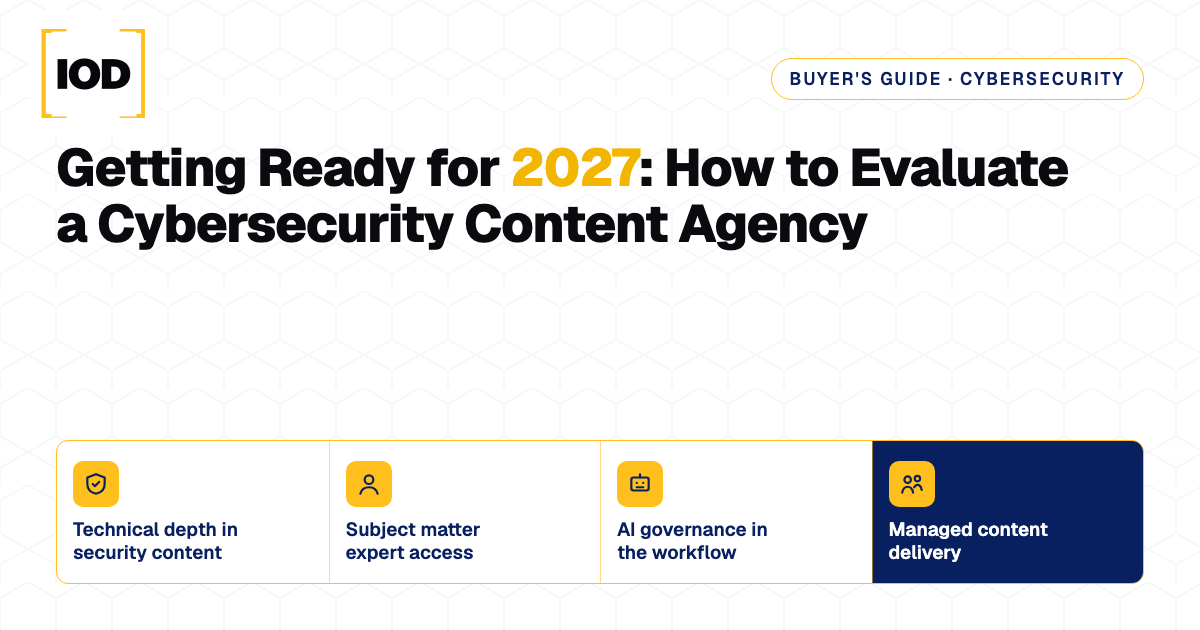
As you plan your 2027 content program, four criteria separate the agencies that prevent that outcome from those that cause it: technical depth, subject matter expert access, AI governance in the content workflow, and managed content delivery. (If you’re still deciding between an agency, an AI platform, or freelancers, start with our comparison of cybersecurity content production options.)
1. Technical depth in security content
The real failure mode is content that clears editorial review and then gets flagged by a security practitioner: wrong CVE framing, outdated threat actor attribution. A generalist editor won’t catch either. As IOD’s analysis of where tech marketing agencies fail on content points out, the typical tech marketing agency doesn’t have a single tech expert on staff, so the plausible-but-wrong draft is the predictable default, not the exception.
AI widens this gap. An AI-assisted draft can produce confident, well-structured security content that is wrong in domain-specific ways: wrong on threat modeling logic, wrong on what a compliance certification actually covers. The terms (SOC 2, CSPM, NIS2) appear correctly; the underlying claim does not.
- Ask for published work on comparable security topics, and have a technical reviewer assess its accuracy before you sign anything.
- Ask about the expert writer’s background in your security domain. Threat modeling, cloud security, and compliance are distinct specialties, not interchangeable ones.
- Ask the agency to explain the difference between SOC 2 Type I and Type II in a content context. It’s a practitioner-level qualification signal, not a trick question.
Agencies with real expert writers on their bench onboard faster than generalist agencies, because their writers arrive with domain knowledge in place. That cuts your internal briefing overhead from the first engagement. Those writers also contribute knowledge, not just capacity: they research your product and market on their own, surface angles your team hasn’t considered, and challenge assumptions before a draft reaches review. Over time, that sharpens how your product is framed for technical buyers.
In an AI-native workflow, the question is no longer whether expert writers cost more, but whether the agency’s AI is governed by expert judgment or replaces it. An agency that uses AI to scale expert-led work is a different proposition from one that uses AI to skip the expert entirely. For assets where accuracy is non-negotiable, IOD’s long-form content (white papers, e-books, and research publications) is built on that foundation.
2. Subject matter expert (SME) access: structural capability vs. sales claim
SME access as a structural capability means the agency has a vetted bench of expert writers and security practitioners, not one contractor on standby for the sales call.
Across thousands of tech articles written for leading cybersecurity brands since 2017, we’ve found that SME availability is the core production bottleneck: the people who can verify a technical claim are the same people fighting fires, patching systems, or on a call with a customer. What agencies most often do is present ad hoc access (one contractor, or writers who sat through a product overview call) as a structural capability.
When you qualify a vendor, meet the expert writers who will actually work on your content. Evaluate their technical background, their ability to challenge your assumptions, and the insight they bring before production begins. A real expert writer can grasp your message and research your product and market without hand-holding, which means fewer calls, fewer briefing cycles, and less coordination for your team. That independence is also what lets the agency contribute knowledge your team can absorb, not just content your team has to validate.
Vetting question:
- “Who specifically will write about [your domain: CSPM, threat intelligence, cloud compliance], and what is their operational background in that area?”
The first engagement cycle will still need some involvement from your side: initial context-setting and access to internal experts for edge cases. That’s reasonable. The difference is between an agency that coordinates that process for you and one that needs you to drive it continuously.
3. AI governance in the content workflow
When AI generates unverified security claims, your target audience notices. Security architects spot hallucinated CVEs and fabricated compliance assertions, and when they do, the brand that published them loses the room. The pattern is documented: in mid-2026, dozens of AI-hallucinated SQLite vulnerabilities reached official vulnerability databases before they were caught, and in MaxAEO’s test of 1,440 AI-generated answers (July 2026), 66% of the answers that made specific compliance claims (SOC 2, HIPAA, GDPR) contained at least one factual error.
Search engines care too. After its March 2024 core update and new spam policies, Google reported 45% less low-quality, unoriginal content in search results (Google, measured after the rollout completed in April 2024). AI-generated content isn’t penalized for being AI-generated; content made mainly to manipulate rankings, without real value for readers, is. Expert writers governing the technical claims, rather than AI generating them unchecked, is what keeps content on the right side of that line.
AI is valuable for research, retrieval, and structural drafting. Human judgment must govern technical claims, threat landscape accuracy, compliance assertions, and CVE descriptions. Brands that rely on SEO/GEO/AEO agencies publishing AI output without expert review, including brands running fully automated websites for performance marketing, are taking on a large, uncontrolled credibility risk.
There’s no industry standard yet for how content agencies should govern AI in security content, so you’re assessing claims the agency makes about itself. Ask for concrete examples, not category names.
Vetting questions:
- “Where exactly does AI enter your workflow for a security topic, and where does an expert writer with security domain knowledge review the technical claims?”
- “When your AI produces a CVE description or a compliance assertion, who validates it before publication?”
4. Managed content delivery: what your team owns vs. what the agency owns
Managed content delivery means the agency owns the calendar, coordinates SME access, manages review rounds, and runs editorial planning. Your team approves the work and gives direction.
AI sped up drafting without fixing review and governance. Jasper’s State of AI in Marketing 2026 report (a survey of 1,400 marketers, published January 2026) found that 91% of marketing teams now use AI, up from 63% a year earlier, and that friction from legal, compliance, and brand review grew 3.4x year over year, making it the leading blocker to scaling AI. Agencies now have more output to manage with the same structural gaps as before. Content marketing managers who describe a failed “managed” retainer tend to describe the same pattern: they ended up owning the calendar, chasing schedules, and managing revision rounds themselves, while paying for a writing service without the expert writers to back up the volume.
A fully owned delivery model reduces your team’s overhead faster, because expert writers arrive knowing the domain and need less hand-holding to reach a publishable draft. Briefing cycles shrink, review rounds get shorter, and your team stops re-explaining context a domain expert should already have. The most revealing vetting question is still the direct one: “Walk me through what my team owns week to week versus what you own.”
IOD’s enterprise model is built around this distinction: a dedicated team, an account editor, SME coordination, and a single account manager. Strategy and editorial planning covers the layer above it: a six-month calendar, competitive research, and SEO/GEO/AEO strategy owned by the agency, not handed back to your team.
For a long-term engagement, the real thing to evaluate is whether the setup compounds into an agency that runs without constant direction, or resets every time. The best agencies don’t stay vendors. They build enough knowledge about your product, audience, and positioning to work as a strategic partner: one that challenges your messaging, flags gaps in your coverage, and contributes to how you go to market, not just executes a brief.
The four-filter checklist for evaluating a cybersecurity content agency
Use these four filters on every agency on your shortlist:
| Filter | What good looks like | Question to ask | Red flag |
|---|---|---|---|
| Technical depth in security content | Published security content a practitioner would approve, by expert writers with named, verifiable domain credentials | Can we meet the expert writers who will work on our content? | Only generalist writers, or samples that a technical reviewer flags |
| Subject matter expert (SME) access | A named expert for your security domain, with an operational background, who catches errors before publication | Who will write about our domain, and what is their background in it? | One contractor “on call,” or writers who only sat through a product overview |
| AI governance in the content workflow | A specific checkpoint where an expert with security knowledge reviews every technical claim | Where does AI enter your workflow, and who validates CVE and compliance claims? | “AI-assisted, human-reviewed” with no specific checkpoint |
| Managed content delivery | The agency owns the calendar, SME scheduling, and review coordination | What does my team own week to week versus what you own? | Your team ends up chasing schedules and revision rounds |
Meeting all four criteria at once is rare. It’s what IOD’s strategy and editorial planning and fully managed enterprise model are built for: absorbing the overhead these criteria expose, so your team approves and directs instead of coordinating.
Final notes
The four-filter framework is a starting point, not an end point. The agencies worth working with long term are the ones whose capability compounds: each engagement cycle captures learning that improves the next, instead of resetting with every brief. The tenth asset produced with that context in place should be more accurate and faster to approve than the first.
We’ve measured this in our own workflow. After a year of tracking review time across client projects, IOD’s client review cycles became 40% faster (IOD internal workflow measurement, reported in IODigest, January 2026). It isn’t a guaranteed outcome for every engagement, but it shows what a compounding model looks like in practice.
If you’re evaluating content partners for your security brand right now, book a call with us. I’m happy to walk through the framework with you and see whether IOD’s model fits what you’re building.
[ FAQ ]
Frequently Asked Questions
What should I look for in a cybersecurity content agency?
Look for four things: technical depth in security content, real access to subject matter experts, clear AI governance in the content workflow, and managed content delivery. An agency that meets all four can produce content your practitioners trust without your team driving every step.
How can I test an agency’s technical depth before I sign?
Ask for published work on comparable security topics and have a technical reviewer on your team check it for accuracy. Meet the expert writers who would work on your content and ask about their background in your domain. A practitioner-level question, such as the difference between SOC 2 Type I and Type II, quickly shows who knows the field.
Does Google penalize AI-generated security content?
Not because it is AI-generated. Google’s spam policies target content produced at scale mainly to manipulate rankings, however it is made. The real risk for security brands is unverified technical claims, which is why an expert should review every CVE description and compliance assertion before publication.
What does managed content delivery mean?
The agency owns the content calendar, coordinates subject matter experts, manages review rounds, and runs editorial planning. Your team approves the work and gives direction, instead of chasing schedules and revisions.
How much will my team still need to do with a managed agency?
Expect some involvement in the first cycle: setting context and giving the agency access to internal experts for edge cases. After that, a good agency carries that context forward, so your role shrinks to approvals and direction rather than continuous coordination.