
[ TL;DR ]
Key takeaways
- AI made drafting faster, and approval didn’t keep up. More drafts from more contributors now head for the same small group of approvers.
- Review rounds multiply in serial review. Decisions that belong in the brief get made on a finished draft, one reviewer after another, and late conflicts send the piece around again.
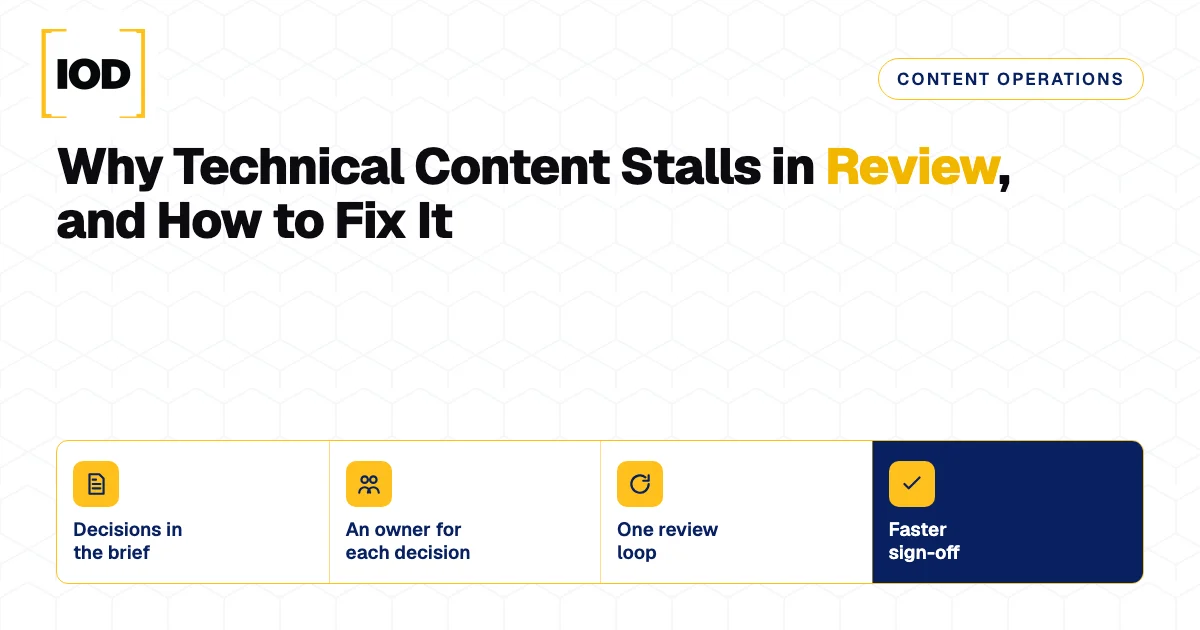
- Give each stakeholder the decision they own. Product marketing, SMEs, legal and an executive author each settle their call in the brief, once.
- Run every comment through one loop. Everyone comments in one draft, and each comment is checked against the brief and brand rules before it’s applied.
Our piece on human-in-the-loop oversight was about one reviewer: where they sit, what they can decide, and whether their corrections change anything. But real publishing rarely has one reviewer. A white paper from a security or cloud company might need sign-off from product marketing, a product or engineering lead, legal, and sometimes an executive whose name is on the point of view.
Those people are there for good reason. In a technical category, a claim about how a product handles data or detects a threat is one a buyer may act on and a competitor may challenge. Publishing it responsibly is a shared job; whoever writes the brief, drafts the piece, reviews it or approves it answers for part of what goes out.
In most teams, though, that responsibility isn’t spread evenly. The content team is the first line of defense, because it writes the claims, and the last, because it publishes them. However, it’s rarely the team best placed to know whether a claim is accurate for the product, or what it implies for a customer who acts on it. So it leans on SMEs to sign off on anything it can’t verify itself, and every piece waits on the few people who can. That single point of failure is where the bottleneck starts.
The Bottleneck Is Growing
AI has made drafting faster without making approval any faster. In Jasper’s own survey of 1,400 marketers, respondents reported a 3.4x year-over-year increase in blockers from legal, compliance and brand review as AI scales; Jasper calls governance “the new blocker to scale.” The number of people producing content is growing too. Forrester expects that by the end of 2026, people outside central content teams will create two-thirds of B2B content, and warns that without guidance, companies risk “diluting their brand.”
More drafts from more contributors, all heading for the same small group of approvers. Teams feel it: in Optimizely’s research, reported by CMO Tech, 54% of marketers said leadership underestimates the human effort it takes to make AI-generated work usable. The day-to-day version is familiar to anyone who has shipped a technical piece: SMEs take longer to review than planned, and their feedback conflicts.
Why Review Rounds Multiply
Most review flows are serial. A draft is written, it goes to the first reviewer, then the next, and each one sees a finished piece and reacts to it, often as much to the last person’s edits as to the draft itself. That’s where the extra rounds come from.
Decisions that belong in the brief get made at review time. Which claim to lead with, which reader the piece is for, what can be said about a competitor: if nobody settled these before drafting, the first reviewer may let them pass, and the next one proposes something different. That change should go back to the first reviewer. If it does, the review starts over; if it’s missed, the piece goes out with a claim the first reviewer never saw.
Conflicts also tend to show up late. Product marketing tightens a claim so it lands with a buyer. The SME puts back the qualifier that made it accurate. Legal then softens the wording of both. Every one of those edits has a fair reason behind it, but the draft now holds three versions of the same sentence, and it goes round again to find out which one stands.
And every round restarts the clock. A reviewer who has to re-read the whole piece to find what changed gives it less attention the third time than the first.
The stakeholders are doing their jobs. The sequence makes those jobs collide.

Give Each Stakeholder the Decision They Own
The fix starts before the first draft. Each stakeholder already owns a decision, whether or not the process says so:
- Product marketing owns the message and the audience.
- Subject matter experts own product truth: what the product does, how, and where its limits are.
- Legal owns claims: what can be stated, and on what evidence.
- An executive author, when there is one, owns the point of view.
When each of those decisions is made in the brief, once, the review that follows has a different job. It checks the draft against what was decided instead of reopening it. It’s the first of the four tests for human oversight of AI: people decide before anything is generated. With several stakeholders, it means the people with the most at stake spend their time on the decisions that set what gets written.
It shortens the review itself, too. A legal reviewer who approved the claims up front reads the draft for whether they were used as approved. An SME who signed off on the technical outline reads for accuracy in the details, rather than for whether the piece is about the right thing.
Run Every Comment Through One Loop
Decisions up front change what review is for; the second half is how comments are handled. In most flows, each round produces a new version, and feedback is spread across email threads, chat and tracked changes in several files. A single loop keeps every stakeholder commenting in the same draft, where they already work, and treats each comment as an input to check before it’s applied.
Checking each comment first matters because one person’s edit can undo a decision someone else made: an SME re-words a claim legal already approved; a sales leader adds a competitor comparison product marketing ruled out. When every comment is checked against the brief and the brand rules before it’s applied, those conflicts come up as questions. Each one goes to the person who owns that decision, and they settle it once.
What It Looked Like at Microsoft for Startups
When Microsoft for Startups needed 15 technical case studies for its #StartupsOnAzure campaign, the stakeholders included SMEs and marketing leads at Microsoft and at every featured startup. Microsoft filled out IOD’s brief before any writing began; IOD then worked directly with each startup to learn its story and get its sign-off. Microsoft reviewed the finished series once, and IOD delivered all 15 within eight weeks, ahead of the deadline (IOD–Microsoft case study, 2023).
“IOD’s streamlined, transparent process gave us full visibility of the production process. This made it easy to keep track of and review the content, all while satisfying multiple stakeholders.”
Amit Svarzenberg, CTO, Microsoft for Startups
Stesh, IOD’s AI engine, now builds that same sequence into the workflow: decisions in the brief, then one loop for comments, each checked against the brief and brand rules before it’s applied.
What Carries Over
One loop makes one piece move faster. The next piece moves faster still if what reviewers corrected doesn’t have to be corrected again. That’s core to the work we’re doing at IOD with Stesh: turning messaging into atomic rules a draft can be checked against. A correction becomes a brand-wide rule only once it recurs across pieces; it’s scored for confidence; the bar rises with its blast radius, meaning how many pieces and audiences it would touch; and an expert approves every promotion.
Four Questions for Your Review Flow
- Who owns each decision: the message, product truth, claims, the point of view?
- When does each stakeholder first see the work, and is it before drafting?
- How many times does each one review the same piece?
- When two comments conflict, where does the conflict go?
If any one of these decisions is first made on a finished draft rather than in the brief, that’s where your extra review rounds come from. The fix keeps the same reviewers making the same calls, just earlier.
Made that way, those calls also outlast the piece. Each decision your reviewers settle becomes part of a shared base the next brief starts from; that’s what IOD’s experts and Stesh are there to keep, so every piece begins with more already decided.
[ FAQ ]
Frequently Asked Questions
Why does technical content get stuck in the content approval process?
Most review flows are serial: each reviewer reacts to a finished draft, often to the last person’s edits as much as to the draft itself. Decisions that belong in the brief, such as the lead claim or the target reader, get made at review time, and late conflicts between product marketing, SMEs and legal send the piece around again.
Who should own which decision in a content review?
Product marketing owns the message and the audience. Subject matter experts own product truth: what the product does, how, and where its limits are. Legal owns claims, and an executive author, when there is one, owns the point of view.
How do you reduce review rounds for technical content?
Settle each owner’s decision in the brief before drafting, so review checks the draft against what was decided instead of reopening it. Then keep every stakeholder commenting in one draft and check each comment against the brief and brand rules before applying it, so each conflict goes to the person who owns that decision.
Does AI make the content approval process faster?
On its own, it adds pressure on approval. AI has made drafting faster without making approval faster: in Jasper’s survey of 1,400 marketers, respondents reported a 3.4x year-over-year increase in blockers from legal, compliance and brand review as AI scales.


