
[ TL;DR ]
Key takeaways
- Review at the end is the weakest place for a human. It’s the default oversight in most AI workflows, and the least able to catch a polished but wrong output.
- “Human in the loop” has drifted. It originally described several levels of oversight, two of them upstream of any single output; it now usually means someone checks before it ships.
- Four tests show whether oversight is real. People decide before generation, the overseer can stop the output, a named person has the time, and corrections change the system.
- Sort steps by ambiguity and risk. For technical B2B content, people should own the brief, the claims, and the call on accuracy; AI supports execution.
Most teams putting AI into their work have answered the oversight question the same way: a person checks the output before it goes out. It’s the default because it’s the easiest thing to add to a process that already exists, and it lets everyone say a human was involved. It’s also the weakest place a human can sit in an AI workflow.
The weakness shows up whether the stakes are one story or a hundred. At Ars Technica, a senior AI reporter and a company policy against AI-generated articles didn’t stop AI-paraphrased quotes, presented as real quotes, from being published. At scale, an operation using ChatGPT placed almost 100 articles in about a dozen news outlets, in part by tuning each draft to the outlet’s submission criteria; it was designed to pass the check at the end.
Neither is a story about missing humans. People were involved in both, but they were positioned at the end, looking at finished work that was polished enough to get through. As AI makes finished work more convincing and far more plentiful, a check at the end has less and less to hold on to.
Getting oversight right comes down to three design choices that most AI workflows leave to default: where the person sits, what they’re allowed to decide, and what happens to what they notice.
What “human in the loop” was supposed to mean
The phrase has drifted. The EU’s Ethics Guidelines for Trustworthy AI, published in 2019, described three distinct levels of oversight:
- Human in the loop: the capability for human intervention in every decision cycle of the system, which the group noted “in many cases is neither possible nor desirable.”
- Human on the loop: intervention during the design cycle, plus monitoring the system’s operation.
- Human in command: oversight of the system’s overall activity, including the ability to decide when and how to use it at all.
These are different jobs, and two of them live upstream of any single output. In practice, the market has collapsed all three into one meaning: someone checks it before it ships. That’s what most people now hear in “human in the loop,” and it’s the version least able to do what oversight is for.
Why review at the end fails
Three things work against the reviewer at the end. None of them is about effort or competence.
The first is automation bias. When an AI system suggested the wrong answer, experienced radiologists’ accuracy fell from 82% to 45.5% (RSNA study of mammogram readers, 2023). Expertise didn’t protect them. Knowledge workers show the same pattern: those more confident in generative AI report thinking less critically.
The second is coverage: how much of the output a person actually reviews. Only 27% of respondents whose organizations use gen AI say employees review all of it before it’s used (McKinsey, The State of AI, 2025). Everywhere else, some AI output goes out with no human check at all.
The third is cost. A polished draft that’s substantively wrong is expensive to fix, because the reviewer has to rebuild the reasoning to find the error. Researchers at BetterUp Labs and Stanford call this “workslop,” AI-generated content that “masquerades as good work, but lacks the substance” to move a task forward, and estimate nearly two hours of rework per instance. Content teams are paying that cost now: CMO Tech reports that 76% of marketing leaders spend at least three hours a week editing, fact-checking, or correcting AI-generated material, and 25% knowingly publish off-brand AI content under deadline (Optimizely survey of 2,003 marketing leaders in seven markets).
Yes, the review is happening. But it’s happening where it’s least likely to catch the problem, and where it’s most expensive when it does.
What the person at the end becomes
When the only human role is a final check, the role changes shape. Ben Green, writing about government algorithms, argues that human oversight policies “provide a false sense of security in adopting algorithms.” The policy says a person is responsible; the design gives them little to be responsible with.
Others have named what that person becomes. Madeleine Clare Elish calls it a moral crumple zone, where “responsibility for an action may be misattributed to a human actor who had limited control” over the system. Dan Davies’ idea of the accountability sink describes the same thing from the organization’s side; as Mandy Brown summarizes it, these are “structures that absorb or obscure the consequences of a decision” so that no one can be held directly accountable for it. Cory Doctorow’s reverse centaur is “a machine that uses a human being as its assistant.”
Each term describes the same design flaw from a different side. The human is present and carries the blame, but has little control over the outcome.
Four tests for oversight that’s real
Moving the person earlier in the workflow is only part of the fix. Their role also needs real authority, and a way for what they catch to change the system. Four tests show whether it has them.
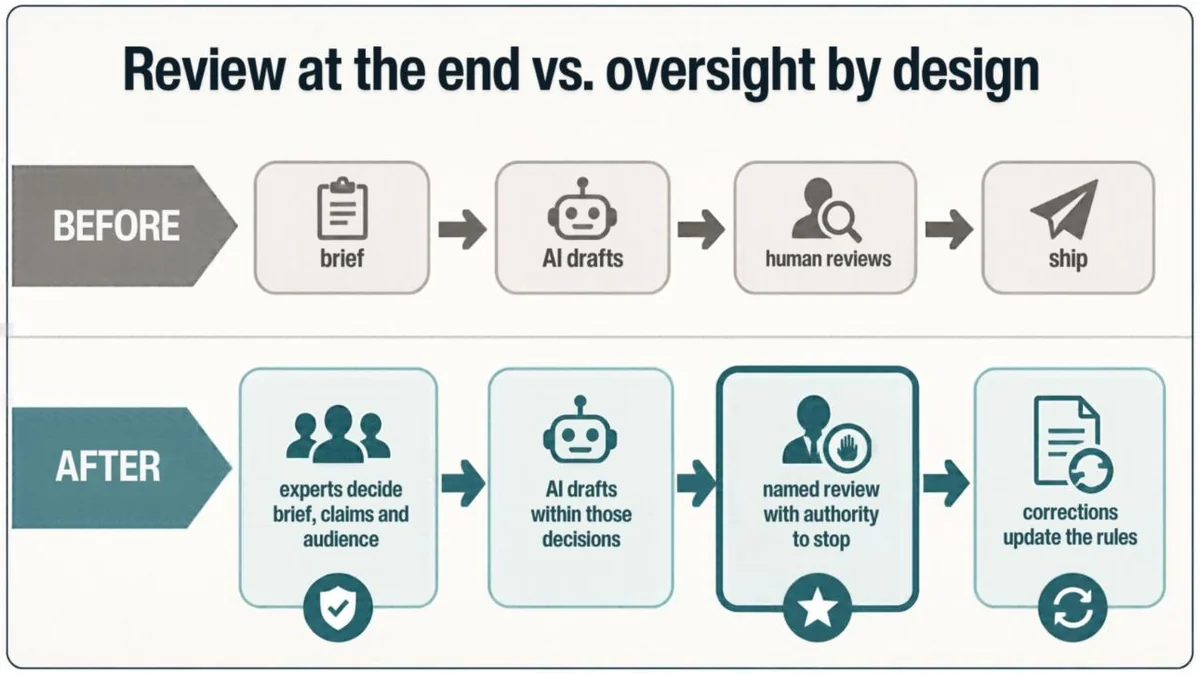
1. People decide before anything is generated. The most consequential decisions in an AI workflow are made before the first output: what the work is for, who it’s for, what it must not say, and what good looks like. MIT CISR’s June 2026 research on decision rights puts it directly: “Business units own the framing of each AI use case, anchoring agents in business need, value, and domain expertise.” Ben Green’s research on government algorithms reaches the same conclusion: the case for using a system, and for the oversight around it, should be justified and approved before the system is adopted. Oversight that starts after generation is inspection.
2. The overseer can stop the output. A reviewer who can only flag is an advisor. The EU AI Act sets a useful bar for high-risk systems: the people overseeing them must be able to “disregard, override or reverse the output” and to “interrupt the system through a ‘stop’ button or a similar procedure.” Marketing content isn’t high-risk under the Act, so this isn’t a legal claim about your workflow. It’s a design standard worth borrowing: if the person responsible can’t stop something going out, they aren’t overseeing it.
3. A named person, with time to do it. Oversight assigned to “the team” or “legal” is oversight assigned to no one. Accountability is also a counterweight to automation bias; Thomas Dratsch, lead author of the radiology study, noted that readers who “feel accountable for their own decisions” are less prone to it. McKinsey found that AI high performers more often “have defined processes to determine how and when model outputs need human validation to ensure accuracy.” Defined means someone has decided which steps need a human, which human, and how much of their week it takes.
4. Corrections change the system. An accountability sink absorbs a correction and nothing changes; the same error comes back next week. Real oversight routes what the reviewer catches back into the brief, the rules, or the workflow, so the next output starts from a better place. Sandra Durth at McKinsey puts the stakes plainly: “When AI can act without waiting for human permission, vague decision rights and implicit accountability become liabilities.”
Most end-of-line review fails at least two of these, usually the first and the last.
Where to put people in your own workflow
Not every step needs a person deciding. Some need a person watching, and treating the two the same either slows everything down or spreads attention thin. The MIT CISR matrix is a quick way to sort steps by two questions: how ambiguous is the decision, and how costly is a wrong one?
- Low ambiguity, low risk (automate): framing is codified in advance; AI acts and learns, with people monitoring.
- Low ambiguity, high risk (manage): AI works inside a design built for reliability; people monitor and handle exceptions, and a named risk owner owns the learning.
- High ambiguity, low risk (enable): framing evolves as people and AI work together; people monitor what the AI does, and the learning stays with them.
- High ambiguity, high risk (lead): executives own the framing and the learning; AI supports execution.
The researchers’ example of AI-generated campaign ideas and content, from One NZ’s marketing team, sits in the enable quadrant. That holds for a lot of marketing. It shifts for technical B2B content, where a wrong claim about how a product handles security or data is costly to retract and costs trust with exactly the buyers you’re trying to reach. For that work, the framing moves into lead: the brief, the claims, the audience, and the call on what’s accurate belong to people who know the domain.
The useful exercise is to map each step of a workflow onto the matrix before choosing a tool, and to write down who owns each step. The gaps show up quickly.
How we do it at IOD
We rebuilt IOD’s content pipeline around these tests. We call the model expert-directed: experts first, not last.
Our technical experts set the brief and approve the outline before Stesh, our AI engine, drafts anything; Stesh’s audience and topic research informs those decisions rather than replacing them. Every piece has two named reviewers, one technical and one editorial, and most of their time goes into the brief and outline rather than into rewriting a finished draft. When client contributors comment in the draft, review agents first check each change against the brand rules and the brief’s intent, so a revision doesn’t introduce drift by accident; the comments are then applied to that piece.
The harder design question is when a correction should outlive the piece it was made on. The approach we’re refining now is a promotion threshold. A correction becomes a brand-wide rule only once it recurs across pieces; it’s scored for confidence by who made it and how consistently it points the same way; and the bar rises with its blast radius, so a change that would reach every piece and audience needs more evidence than one that touches a single format. An expert approves every promotion. One reviewer’s preference on one draft stays on that draft.
It isn’t the only way to pass the four tests. But for now, it’s the way we’ve found to keep expert time on decisions instead of cleanup.
Four questions for any AI deployment
Before your next AI workflow goes live, in content or anywhere else, ask:
- Where is the first human decision, and does it come before generation?
- Can that person stop the output?
- Who is named, and is the time in their week?
- Does their correction change anything next time?
If the honest answers are “at the end,” “not really,” “the team,” and “no,” the workflow has a human in it and no one overseeing it.
[ FAQ ]
Frequently Asked Questions
What does “human in the loop” mean in AI?
The EU’s 2019 Ethics Guidelines for Trustworthy AI define it as the capability for human intervention in every decision cycle of a system. The guidelines separate it from human on the loop (design and monitoring) and human in command (deciding whether and how to use the system at all). In practice, most teams now use the phrase to mean someone checks the output before it ships.
Why isn’t reviewing AI output at the end enough?
Three things work against the reviewer at the end: automation bias, which makes even experts accept wrong AI suggestions; low coverage, since most organizations don’t review all AI output; and cost, because a polished but wrong draft takes a long time to fix. The review happens where it’s least likely to catch the problem.
What are the four tests for real human oversight of AI?
People decide before anything is generated, the overseer can stop the output, a named person has time in their week to do it, and their corrections change the system. A workflow that fails these has a human in it but no one overseeing it.
Where should people sit in an AI content workflow?
Map each step by how ambiguous the decision is and how costly a wrong one would be. For technical B2B content, where a wrong claim about security or data costs trust with buyers, people should own the brief, the claims, the audience, and the call on accuracy, with AI supporting execution.


