[ TL;DR ]
Key takeaways
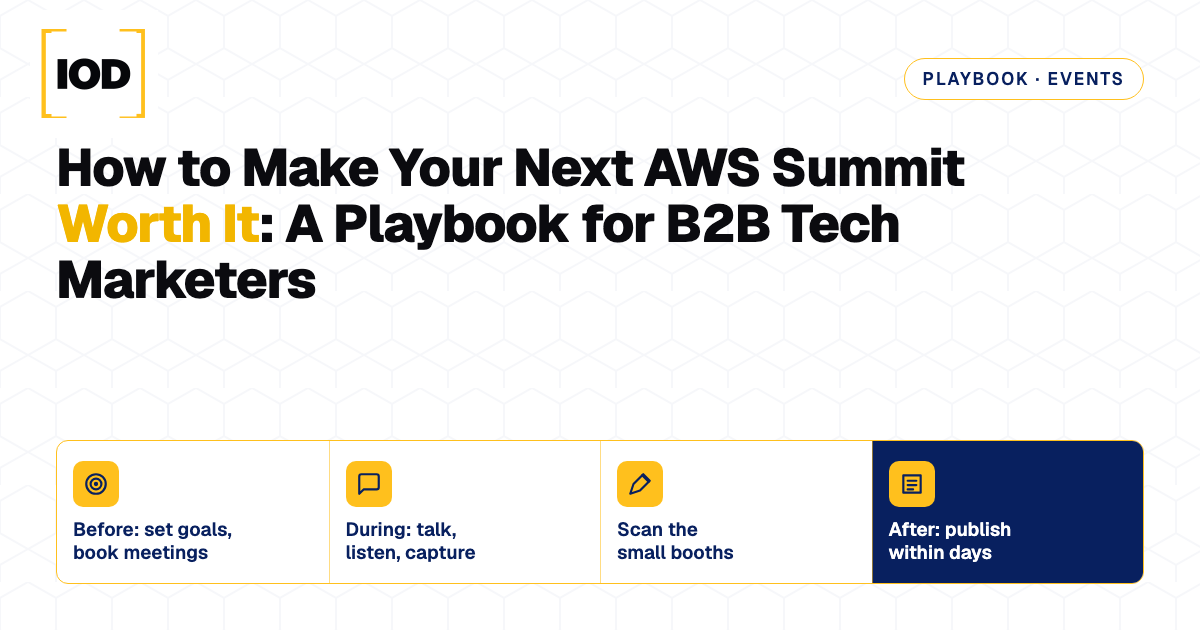
- Decide what the Summit is for before you register. Pick one or two goals, such as pipeline, practitioner insight, or content, and plan meetings and assets around them.
- Conversations beat laptops. The most valuable hours are the ones you spend talking with practitioners at booths, in session lines, and at the reception.
- The smaller booths show you where the market is heading. A quick walk past the emerging vendors gives you an early read on new categories, messaging, and competitors.
- Capture insights as you go. A simple shared note for quotes, objections, and questions turns a busy day into raw material for content and sales.
- Publish within days, not weeks. A recap post, a LinkedIn series, and a sales follow-up asset keep the Summit working for you long after the Expo closes.
AWS Summits bring builders, buyers, partners, and vendors into one room for a day (sometimes two), and for B2B tech marketers that concentration is hard to find anywhere else. Whether your company has a booth on the Expo floor or you are attending with a badge and a notebook, the Summit can feed your pipeline, sharpen your messaging, and fill your content calendar for weeks. It all depends on how you plan the day.
Back in 2018, IOD expert and engineer John Fahl wrote a post for this blog about getting real value out of an AWS Summit as an attendee. His advice still holds: talk to people instead of your laptop, spend time at the small booths where emerging tech lives, and treat every conversation as a chance to learn. This refreshed playbook keeps those ideas and adds the marketer side: what product marketing, demand gen, content, and field marketing teams can do before, during, and after the event.
What an AWS Summit Offers B2B Tech Marketers
AWS describes its Summits as free in-person events for builders and innovators to learn and make new connections. They run in cities around the world throughout the year. Most are one-day events, while a few, such as AWS Summit Washington, D.C., run over two days. A typical Summit includes a keynote, technical breakout sessions, hands-on training, and an Expo where AWS partners and sponsors run booths. For the New York event, AWS notes that registration is complimentary and includes access to sessions, the Expo, meals, and receptions.
That format makes the Summit a different animal from AWS re:Invent. It is shorter, more local, and the audience leans toward practitioners who are actively building on AWS. For marketers, that means three things in one place:
- Your buyers and users, in a setting where they are open to conversation.
- Your competitors and adjacent vendors, showing their latest positioning on the Expo floor.
- AWS itself, including partner teams and the topics AWS chooses to put on stage.
For a recent example of how much ground a single AWS event covers, see our notes from AWS re:Invent days 1 and 2.
Before the Summit: Set Goals and Prepare
Pick one or two goals
A Summit day goes by fast, so choose what success looks like before you arrive. Common goals for marketing teams include:
- Pipeline: a target number of qualified conversations or booked follow-up meetings.
- Practitioner insight: a list of questions you want real users to answer, such as how they evaluate tools in your category.
- Content: a set number of quotes, stories, or ideas you plan to turn into posts, videos, or sales assets.
- Market intelligence: a clear picture of how competitors and emerging vendors are positioning themselves.
Write the goals down and share them with everyone attending from your company. When sales, product, and marketing agree on the same two goals, the team spends the day pulling in the same direction.
Book meetings early
Reach out to customers, prospects, and partners in the Summit city a few weeks ahead. A short invitation to meet at your booth, grab a coffee near the venue, or join you at the reception works well. Include your AWS partner contacts too, since the Summit is a natural place to strengthen that relationship. If co-marketing with AWS is on your roadmap, our guide to getting published on the AWS APN Blog is a useful conversation starter.
Prepare your content and booth assets
Review the agenda as soon as AWS publishes it and match the session topics to your own content. If the agenda leans into a theme your product addresses, have a relevant technical post, demo, or one-pager ready to share. For exhibitors, that also means:
- A booth message a practitioner can understand in five seconds.
- A short live demo that solves one real problem.
- A leave-behind with a clear next step, such as a technical guide or a tutorial link.
- Swag people will actually keep. Our tips for creating conference swag cover what works for technical audiences.
Finally, set up a capture template before the event: a shared doc or form with fields for name, role, company, the problem they described, any quotable line, and whether they agreed to be quoted. It takes ten minutes to build and pays off for weeks.
During the Summit: Talk, Listen, Capture
Talk to people, not your laptop
John’s original observation still rings true: thousands of people gather in one place, and many of them spend the gaps between sessions catching up on email. Save the inbox for the trip home. Waiting in a session line, standing near a demo, or sitting at lunch are all easy openings for a conversation. Ask what people are building, what is slowing them down, and which sessions they plan to attend. You will learn more about your market in those five-minute chats than in most surveys.
John also made a habit of thanking vendors whose products he used. Marketers can flip that idea: thank the customers and partners you meet, and ask them what they like about your product. Those moments often turn into the warmest conversations of the day, and sometimes into case study leads.
Run booth conversations that teach you something
If you are exhibiting, staff the booth with at least one person who can go deep technically. Practitioners respond to someone who can talk through architecture, not only features. Open with a question about their environment instead of a pitch, and listen for the words they use to describe their problems. That language is gold for your website, ads, and content.
Capture practitioner insights and customer quotes
Use your capture template throughout the day, right after each conversation while details are fresh. Record:
- The exact phrasing of a pain point or win.
- Questions you heard more than once.
- Objections and how you answered them.
- Any customer story worth a follow-up interview, along with their consent to be quoted.
Always confirm permission before you quote anyone by name, and send the quote back for approval before publishing. A short, approved quote from a practitioner carries more weight than a page of marketing copy.
Walk the small booths for a competitive scan
The big sponsors are easy to find. John’s advice was to spend time at the small kiosk booths, because that is where the newest tech shows up and where you often talk directly to a founder or lead engineer. He remembered seeing a company in a tiny booth one year and in a large main booth the next.
For marketers, these booths are an early signal of where your category is heading. Set aside 30 to 45 minutes to walk them and note:
- New categories or problems that vendors are naming.
- Messaging that stands out, and why.
- Companies that could become partners, integrations, or competitors.
- Demo formats that drew a crowd.
Bring those notes back to product marketing. A quick internal summary of what you saw is one of the most valuable things a Summit can produce.
Choose sessions with content in mind
Pick a few breakout sessions that connect to your product area or your customers’ challenges. Arrive early, since AWS notes that seating is first come, first seated. Listen for the problems speakers highlight and the questions attendees ask afterward. Those questions show you what your audience still needs explained, which is exactly where your next technical article should go.
Throughout the day, remember that your badge represents your company. Friendly, professional conversations with everyone, competitors included, open more doors than they close.
Planning your next conference calendar? See our CyberMarketingCon 2025 field insights and ROI signals.
After the Summit: Turn Insights into Content Fast
The Summit’s value peaks in the days right after it ends, while attendees still remember the conversations and your sales team still has warm follow-ups. Aim to publish your first piece within a few days.
Publish a practitioner-focused recap
Skip the generic announcement roundup. Instead, write a recap built on what you heard: the three problems practitioners raised most often, what that means for teams in your space, and how to address them. Add approved quotes and link to the sessions you attended. A recap like this stays useful long after the event news cycle moves on.
Turn insights into a LinkedIn series
Each strong insight can become its own short LinkedIn post from a team member who was there. One post per day for a week keeps the conversation going and reaches people who could not attend. Personal, first-hand observations tend to resonate more than company-page updates.
Equip sales with follow-up assets
Give your sales team something more useful than “great to meet you.” Good options include:
- A one-page summary of the top practitioner questions, with your answers.
- A technical guide that goes deeper on the topic a prospect raised at the booth.
- A short video walkthrough of the demo they saw. Our step-by-step guide to tech video tutorials shows how to make one quickly.
Feed your content roadmap
Review your capture notes as a team within a week. Repeated questions become blog topics. Customer stories become case study candidates. Competitive notes become positioning updates. When you plan this way, one Summit can shape a full quarter of content.
That last step, turning raw event insights into accurate technical content quickly, is where many teams get stuck. It is also what IOD does every day: our practitioner writers and editors help cloud, cybersecurity, and AI infrastructure vendors turn field conversations into technical content their buyers trust.
[ FAQ ]
Frequently Asked Questions
Are AWS Summits free to attend?
Yes. AWS describes its Summits as free in-person events. For AWS Summit New York, AWS notes that complimentary registration includes access to sessions, the Expo, meals, and receptions.
How is an AWS Summit different from AWS re:Invent?
AWS Summits are free regional events that usually last one day, and a few run over two days. They take place in cities around the world throughout the year. re:Invent, which AWS calls its premier cloud and AI conference, runs for a full week in Las Vegas, so a Summit offers a more local, focused setting for meeting practitioners.
Is an AWS Summit worth it for marketers who are not exhibiting?
Yes, if you go with clear goals. Attending lets you talk with practitioners, scan competitor and emerging-vendor messaging on the Expo floor, and gather quotes and ideas for content. Many of the most useful insights come from conversations, not booths.
What should marketers capture at an AWS Summit?
Capture the exact words practitioners use to describe their problems, questions you hear more than once, objections, and customer stories worth a follow-up. Always confirm permission before quoting anyone by name. A simple shared template keeps the whole team’s notes in one place.
How soon should we publish content after the Summit?
Aim for your first piece within a few days, while attendees and prospects still remember the event. Start with a practitioner-focused recap and a short LinkedIn series, then build deeper technical content and sales follow-up assets from your notes.