Originally published · Updated
[ TL;DR ]
Key takeaways
- Pick the right people to meet and the right sessions to attend. Everything else is logistics.
- Record every conversation you can and funnel it all into one place so transcription and processing are systematic.
- When you get home, you have months of ammo: stories, anecdotes, and real practitioner language you can turn into social posts, community discussions, and long-form content.
- Route technical claims to a practitioner, messaging updates to PMM, and get quote permission before anything publishes.
- Know what you want to learn before you go. This year I’m tracking AWS Context and Amazon Bedrock AgentCore, how AWS supports builders (Kiro and the AWS Builder Center), and AI security (AWS Continuum).
I’ve attended every AWS re:Invent since 2012. 2026 is my 15th. This year I’m doing the same back-to-back trip I’ve done before: Austin for CyberMarketingCon (November 15–18), then home for a week, then Las Vegas for re:Invent.
Last year re:Invent drew about 70,000 attendees. If you’re an executive, a product manager, a product marketer or anyone in GTM, at re:Invent you are surrounded by engineers who are your buyers, your partners and your competitors’ customers, across six Las Vegas venues.
Treat it as a buyer research week: pick the right people to meet and the right sessions to attend, listen and record everything, and come home with months of material for your GTM and content plans. In this article, I’ll share what I’m most interested in learning this year and practical tips from attending this amazing event so many times.
What I want to learn at re:Invent 2026
re:Invent brings hundreds of announcements, sessions and discussions, so focus on the AWS products most relevant to your venture. That focus tells you which AWS reps, solution architects and partner teams you should try to meet. As for me, I’m a recognized independent industry analyst for several tech brands. AWS has been my favorite for years, and not only because they take great care of their analysts: it’s the innovation and the culture.
Obviously, AI is at the center of almost everything I want to understand this year. These are the three areas I’m tracking going in.
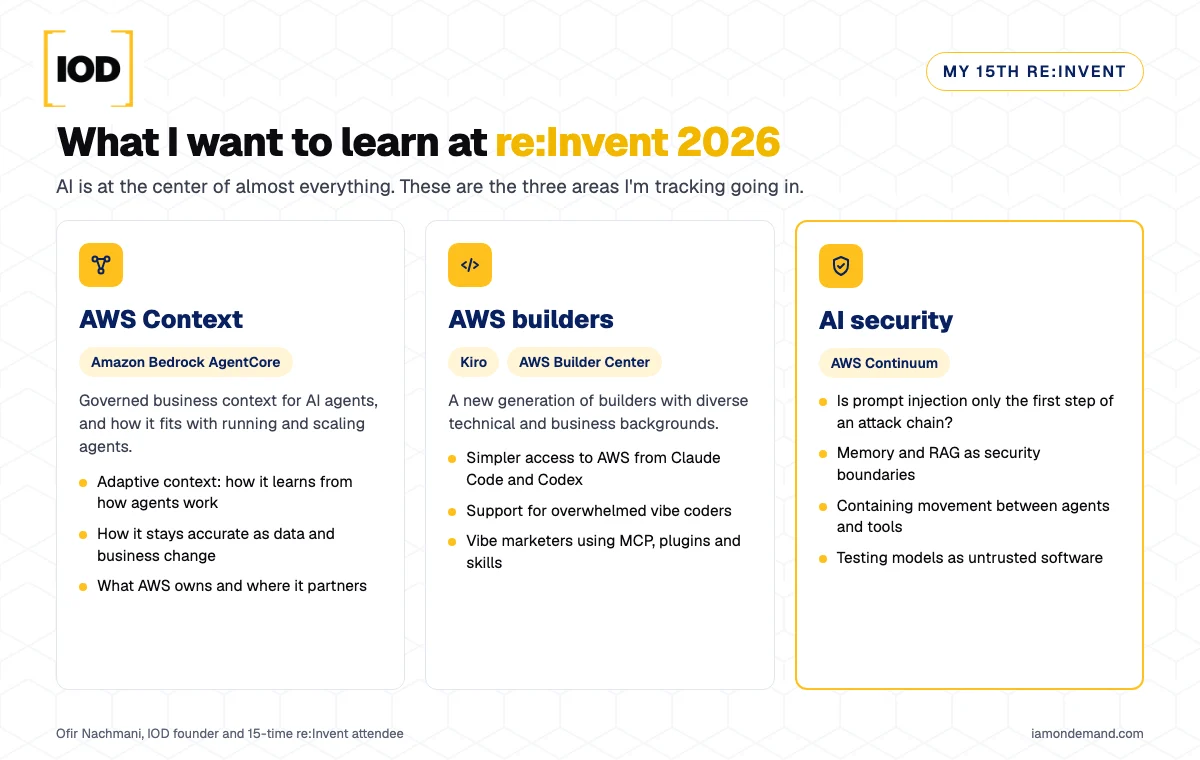
AWS Context. I want to understand the route AWS is taking with AI agents, and specifically how AWS Context shapes that direction. AWS Context is AWS’s knowledge graph service that gives AI agents governed business context. AWS announced it at AWS Summit New York in June 2026, and it’s listed as coming soon. What interests me most is what AWS calls context that learns from how your agents work. As agents query the graph, AWS Context observes which sources produce correct results and which join paths agents rely on. It ranks sources by actual usage and shares what one agent learns with the others, without a human re-curating the graph.
I want to see how this adaptive context works in practice, and how it stays accurate and optimized as the data and the business keep changing. I want to understand why AWS makes the choices it makes: which AI capabilities it owns versus partners on, where it draws the line on abstraction, and how that affects the buyers I’m writing for every day. I’ll also be watching Amazon Bedrock AgentCore, AWS’s managed service for running and scaling agents, to see how the two fit together.
AWS builders. AWS uses the term “AWS builders” to describe the developers, architects, and practitioners who build on its platform. I count myself in that group. With AI, this community is expanding to include a new generation of builders with diverse technical backgrounds and business expertise. I’m interested in how AWS plans to support this growing audience through initiatives like the AWS Builder Center.
ICYMI, alongside the rapid growth of Claude Code and OpenAI Codex, AWS has its own agentic engineering platform called Kiro, built around spec-driven development. Given the widespread adoption of these tools, I see a broader opportunity for AWS to simplify the consumption of cloud resources, AI models, data services, and deployment environments across these ecosystems. I question whether the already overwhelmed individual vibe coder who uses Claude day and night has the time or foundational skills to navigate the increasingly sophisticated AWS AI ecosystem, including Kiro and Amazon Bedrock.
GTM professionals, particularly those who consider themselves vibe marketers, represent another emerging audience. They consume cloud capabilities through MCP, ready-made plugins, and reusable skills within their AI environments. As their applications and agentic workflows mature, they need secure, shared execution environments that make these capabilities accessible to their teams and wider organization.
AI security. This has become its own domain, and it’s the one I expect to spend the most time on. AWS Continuum, AWS’s AI-native security service, is high on my list. Beyond the specific product, the questions I want answered:
- Is prompt injection only the first step of a longer attack chain, and how do defenders detect what happens next?
- How do memory and RAG become security boundaries, and can poisoned documents or memory keep an attack alive or send an agent to fetch new instructions?
- How do we contain movement between connected agents and tools?
- What changes when we treat models as untrusted software: how do we test for hidden sleeper behavior, and what evidence would I need beyond a strong benchmark score?
It will be great to deep dive into these at the analyst conference. Many Israeli cybersecurity companies are already building answers to these challenges. You can explore them in IOD’s Israel Cyber 2026 directory.
Get ready
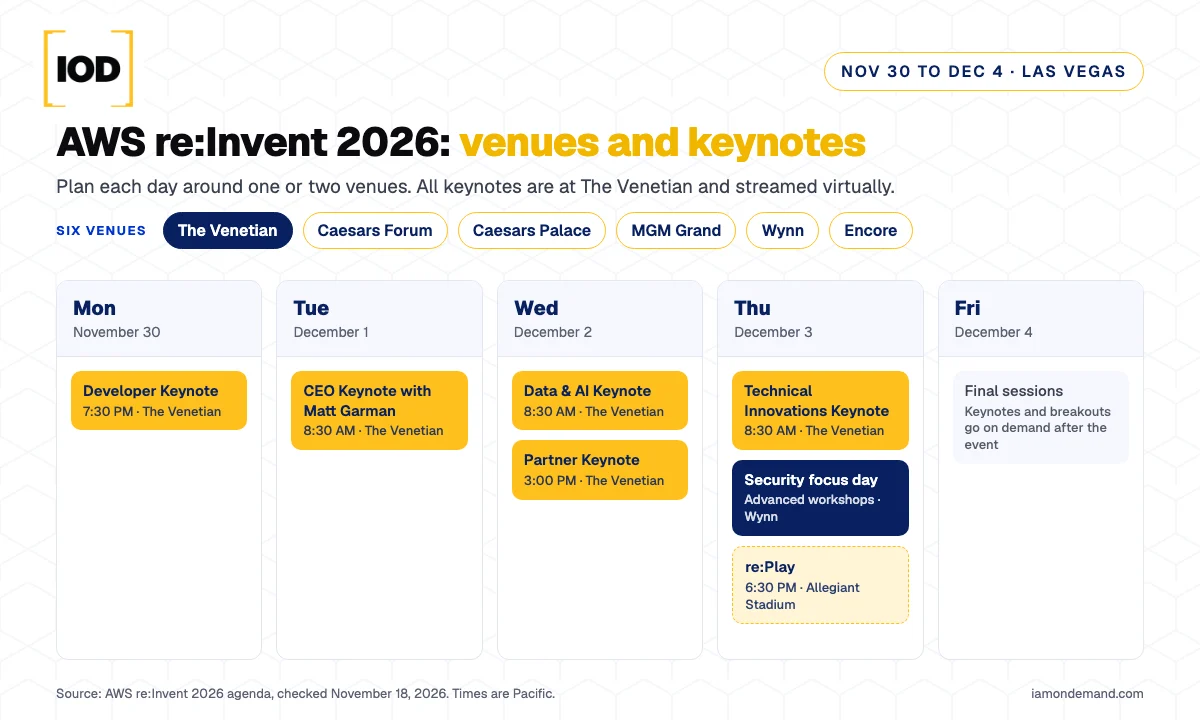
- re:Invent 2026 runs November 30 to December 4 across six Las Vegas venues.
- Reserve seats now for chalk talks, workshops and other reservable formats in the re:Invent attendee portal or the AWS Events app, because popular sessions fill.
- Full pass: $2,499, with no day or expo-only passes. AWS Builder ID required.
- Use the session catalog to plan each day around one or two venues.
Before you land, three things need to be in place: the people you want to meet, the questions worth answering, and the AI agents that will help you track it all. Start with the AI assistant in the AWS Events app, then add a concierge for registration and your calendar, an agenda planner for reserved sessions and venue routing, a people agent for your contact list (LinkedIn checked manually), a parties scout, and a nightly debrief from your voice memos.
Who do you want to meet at re:Invent?
John Fahl first shared these people-first lessons in his 2018 AWS Summit article for IOD. His framework still holds: talk beyond your coworkers, spend time at the small booths where emerging tech lives, thank vendors, and be professional around competitors. Swag can start a conversation, and a good question keeps it going.
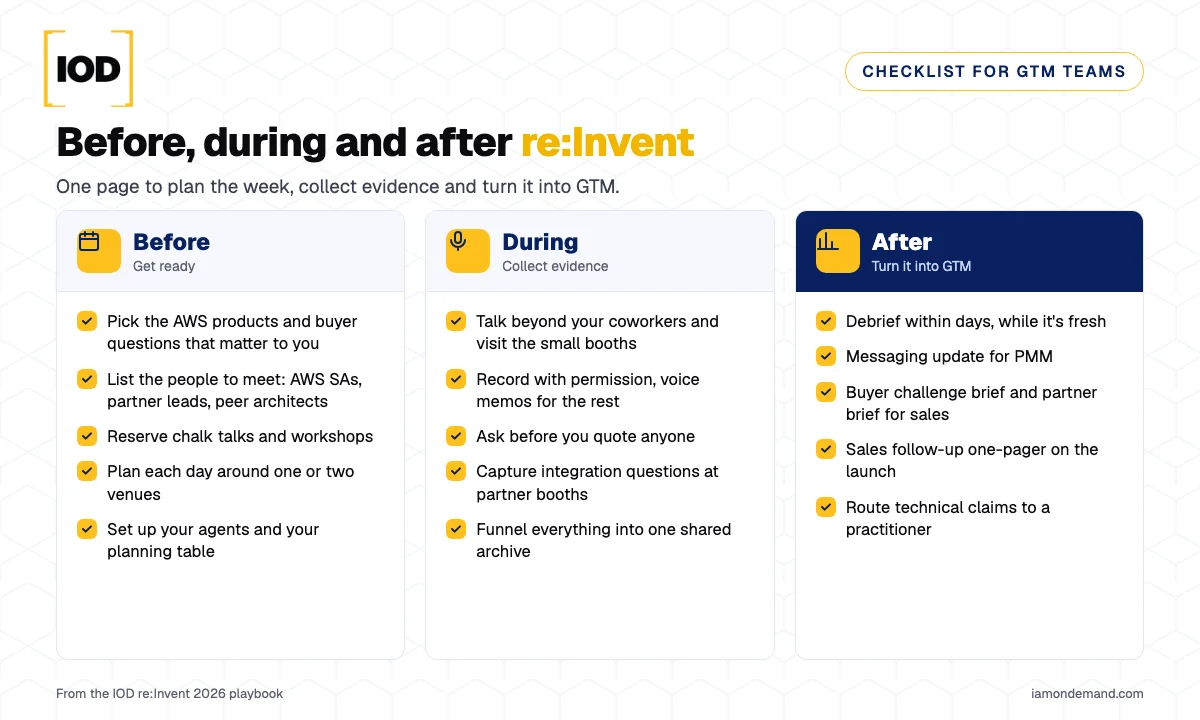
Before the event, build a list of types of people to target: AWS solution architects, partner technical leads, security architects from peer companies, practitioners whose work you’ve read. These are the engineers whose challenges you’re trying to understand and whose language you need to get right in your messaging.
Before you quote anyone, ask. Ask whether they prefer to be named, titled, anonymous, or background only. The same engineers at re:Invent you’re trying to learn from are the audience your GTM needs to reach.
What do you want to ask?
The planning table turns your conference goals into specific buyer questions, meetings, and owners before you land.
The table gets the team to agree on what they’re trying to learn before anyone opens the agenda.
| Buyer problem | Learning question | Session or meeting | Venue | Owner | Output |
|---|---|---|---|---|---|
| Buyers confused about AI agent permissions in CNAPP | What does AWS now say about identity and permissions for AI agents? | Security breakout or chalk talk (a chalk talk is a small-group, whiteboard-format session) | Wynn (security day, Thursday) | PMM | Messaging update |
| Partners asking about data residency for agentic workflows | Which regions does the new capability actually support? | Expo conversation or breakout | The Venetian | Field marketing | Conversation record |
| Sales asking how our product compares after a keynote announcement | Does this launch change our differentiation story? | Meeting with AWS SA | Any | PMM | Positioning note |
PMM owns messaging updates. Field marketing owns conversation records. Your technical colleague owns the claims check before any technical assertion goes into a GTM decision. The goal in every row is a usable insight from a named source.
Note on session formats: breakouts are lecture-style and recorded. Chalk talks and workshops are small-group and interactive. AWS commits only keynotes and breakouts to on-demand, so plan in-person time for the interactive formats.
During re:Invent, collect evidence your buyers will trust
Which sessions should you pick, and how do you record everything?
Go to the sessions tied to the specific buyer questions in your planning table. Record every conversation where someone gives permission, and leave voice memos for the rest. Funnel everything into one searchable archive so transcription and processing stay systematic. Back home, catalog everything by buyer, product, and theme.
That archive changes your messaging. For new products and startups, it’s also the evidence that turns positioning and launch decisions from assumption into something you can defend.
How do you capture what you hear for your team?
| Session or conversation | Announcement or insight | Source (name, role) | Verbatim quote or key claim | Verification needed? | Follow-up owner | GTM implication |
|---|---|---|---|---|---|---|
| [Session ID or meeting] | [Announced, demonstrated, or interpreted] | [Name, role, permission] | [Exact quote or summary] | [Yes or no] | [Owner] | [Buyer decision affected] |
Record the integration questions your buyers are already asking at partner booths: those become the basis for a positioning decision, a sales enablement brief, or an APN Blog article. AWS says only Advanced and Premier tier partners can post to the APN Blog, with exceptions for Select partners that hold an APN program designation such as Service Delivery, and each partner is limited to three posts per year. According to IOD’s guide to getting published on the APN Blog, review typically takes two to four weeks, sometimes six to eight weeks or longer.
After re:Invent, turn evidence into months of collateral
For product and tech marketers, the archive of recordings, transcriptions, and notes you bring back from re:Invent is your content plan for the next few months. The GTM learning comes first: what you heard sharpens your messaging, your positioning, and your sales enablement. The content follows from that.
Debrief within days of returning while the context is still fresh, and turn what you heard into outputs. Four formats do most of the work: a messaging update for PMM, a buyer challenge brief, a partner brief for sales, and a sales follow-up one-pager on how the launch changes your story.
Route technical claims from the expo floor to a practitioner for verification before they go into any GTM asset. Route messaging implications to your PMM for consistency with product positioning. Get quote permission before anything publishes.
Final notes
The practitioners you meet at re:Invent share things your buyers say more openly in person than on a discovery call. Pick the right people, go to the relevant sessions, record everything you can, and funnel it all into one place. Five days of that signal, captured well, is ammo for the whole year ahead.
I’ll be in Las Vegas all week. If you’re a vendor, meet me there, pitch me your product and your values, and get the opportunity to be covered as we start 2027. Good luck at re:Invent, and let’s be in touch. I want to learn about your venture and your latest product or service capability.
[ FAQ ]
Frequently Asked Questions
Can I justify the full pass price without a booth?
Yes, with the right process. The full pass costs $2,499 in 2026, with no day or expo-only passes, and for smaller teams that changes the ROI calculation. Without a booth, your return is qualified conversations, sharper messaging, and GTM decisions you couldn’t have made from a press release.
If I miss a session, can I watch it later?
AWS has confirmed that keynotes and breakouts go on demand after the event. Chalk talks, workshops, and roundtables are not committed to on-demand, so protect those formats for in-person attendance. For the full session schedule and to reserve your spot, use the re:Invent attendee portal.
When is an AWS Summit the better choice?
If your buyers are concentrated in one region, a regional AWS Summit can fit better when its audience and agenda match the questions you need answered. The AWS Summit playbook for B2B tech marketers covers the comparison in full.
How can AI agents help me at re:Invent?
They act as your concierge, agenda planner, parties scout and nightly debrief, so you spend the week in conversations instead of logistics.