[ TL;DR ]
Key takeaways
- We evaluated seven AI-native platforms and managed services, plus one bonus option. The options are IOD, AirOps, Jasper, Growthx, Writer, Profound AI and Peec.ai, plus a homegrown AI content platform. Each is compared on core capabilities, technical-expert involvement, human-led production and pricing.
- Technical expertise and AI context matter. The best AI-native platforms and managed services combine real technical expertise with a deep understanding of your brand, products, audience, and previous work. Maintaining this context helps reduce errors and makes content production more efficient.
- Not all AI-native platforms and managed services solve the same challenge. Some offer fully managed content production (IOD), others combine AI-powered content creation with search visibility (AirOps), while others focus primarily on monitoring brand visibility in AI search (Profound).
- Building a homegrown AI content platform requires more than a GTM engineer. GTM engineers can automate workflows, but reliable brand context, technical accuracy, and quality control require ongoing engineering.
- AI increases the value of expert-led services. Combining AI efficiency with human expertise supports consistent, technically accurate content production at scale.
In this guide, we evaluate seven AI-native platforms and managed services, plus a homegrown bonus option for technical B2B marketing teams, with a focus on how each handles the specific demands of deep-tech content domains such as cybersecurity and developer tools: accuracy on proprietary product knowledge, structural involvement of subject-matter experts, and the real cost of review cycles.
Why Technical Content Is Harder for AI-Native Platforms and Managed Services
Producing technical content with AI comes with challenges that go beyond writing quality. When evaluating AI-native platforms and managed services, five areas matter most:
- Technical accuracy. AI can invent product features, or technical claims that sound convincing but are incorrect. Even a few errors can undermine trust in an entire article. SMEs and PMMs must then verify every claim, increasing the review workload instead of reducing it.
- Maintaining the AI context. A model may handle context well in a short 500-word piece but lose consistency in a 2,000–2,500-word technical article. Research on context comprehension highlights how models can miss or misapply information as context becomes more complex, leading to contradictions and technical inaccuracies.
- Expert involvement. When experts are involved only at the final review stage of an article production, they become a bottleneck. AI-native platforms and managed services should involve experts early, from research and outlining through final approval, to reduce revisions and improve quality.
- SEO/GEO/AEO. Publishing large volumes of low-quality AI content can hurt search visibility over time. Google’s October 2024 developer documentation update reinforced its emphasis on helpful, reliable, people-first content. Technical accuracy, original expertise, and genuine value matter more than simply increasing publishing volume.
- Consistent product knowledge and messaging. AI needs accurate, up-to-date knowledge of your products, competitors, positioning, and target audiences. Without a reliable knowledge base that evolves with your business, content may become outdated, inconsistent, or off-brand.
7 AI-Native Content Platforms and Managed Services + One Bonus Option
We review seven providers using the same criteria: core capabilities, technical-expert involvement, whether production is human-led, and pricing. We start with the overall verdict for each.
IOD Cloud Technologies Research
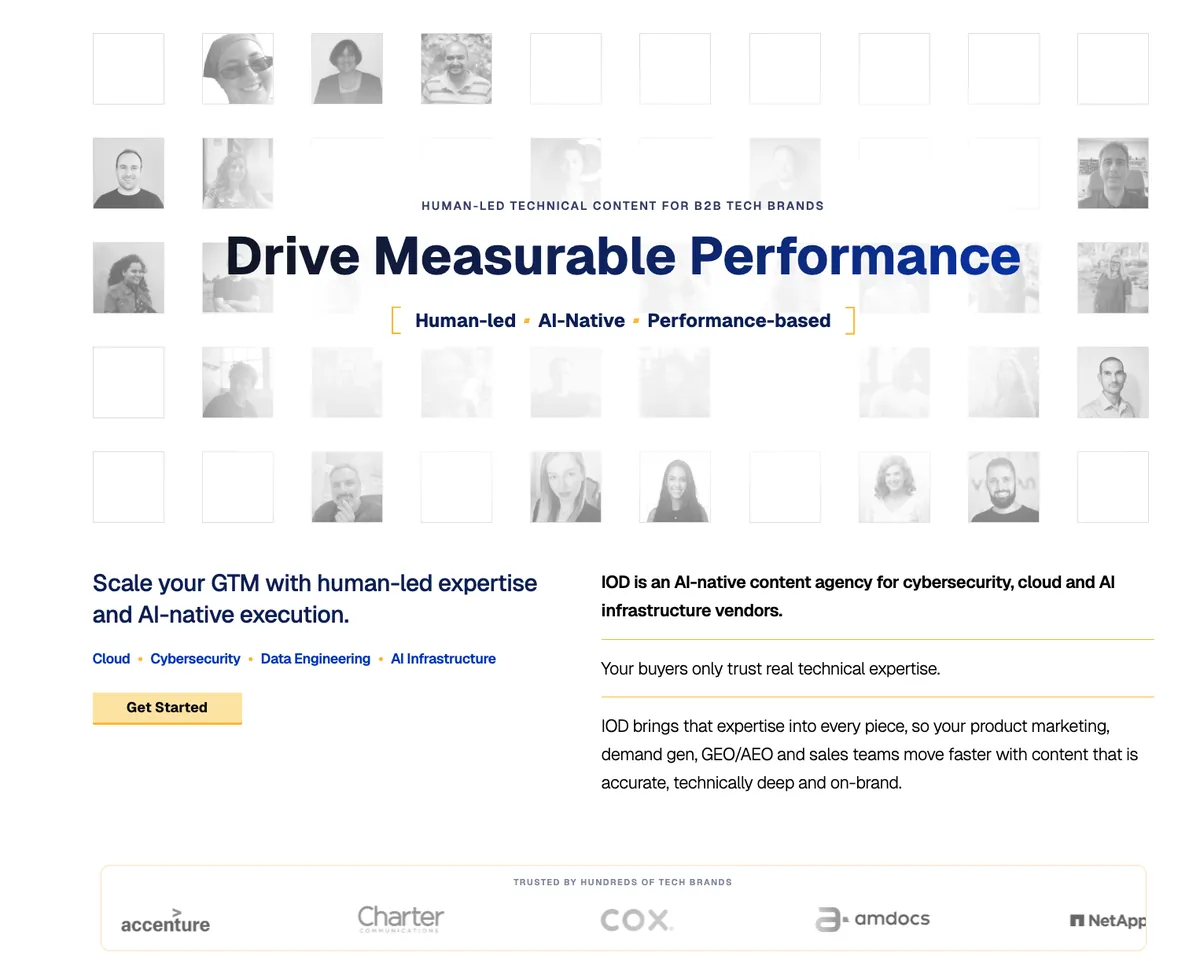
IOD is an expert-led managed content company for B2B technology brands. Humans own ideas, judgment, narrative, technical interpretation, and final approval. AI serves research, retrieval, and governance. Stesh, IOD’s in-house GTM platform, holds accumulated client context: products, buyers, approved claims, prohibited language, prior editorial corrections, so every project starts from what IOD already learned rather than from zero.
Core capabilities: Strategy and editorial planning with CTO-owned technical vetting across all deliverables. Enterprise services for programs requiring scale and delivery management. Long-form technical content, thought leadership, sales enablement, demand gen, SEO/GEO-optimized content.
Tech expert-based: Yes. Practitioners with domain expertise are structurally involved in production. Most platforms or AI native managed services place the PMM or expert at the review stage, making them the GTM bottleneck. IOD places expert judgment upstream, what IOD calls “expert first.”
Human-led: Yes. Humans originate and approve; AI supports, facilitates, and accelerates production.
Price: Managed services start at $5,000/month; custom quotes available above that tier.
IOD offers three delivery models:
- Managed: IOD produces content, with client approval at key stages.
- Hybrid: Client product marketers guide messaging while IOD experts own technical accuracy.
- Self-Service: The client team works directly in Stesh, IOD’s AI platform.
Advantages: Structural expert involvement; persistent context accumulation via Stesh; fully managed delivery. Wiz CloudSec Academy: 60x organic traffic growth, 1,400 top-3 Google keyword rankings, most articles approved in a single review cycle.
Disadvantages: IOD focuses solely on tech and cyber companies, while other tools support more industries, including B2C.
AirOps
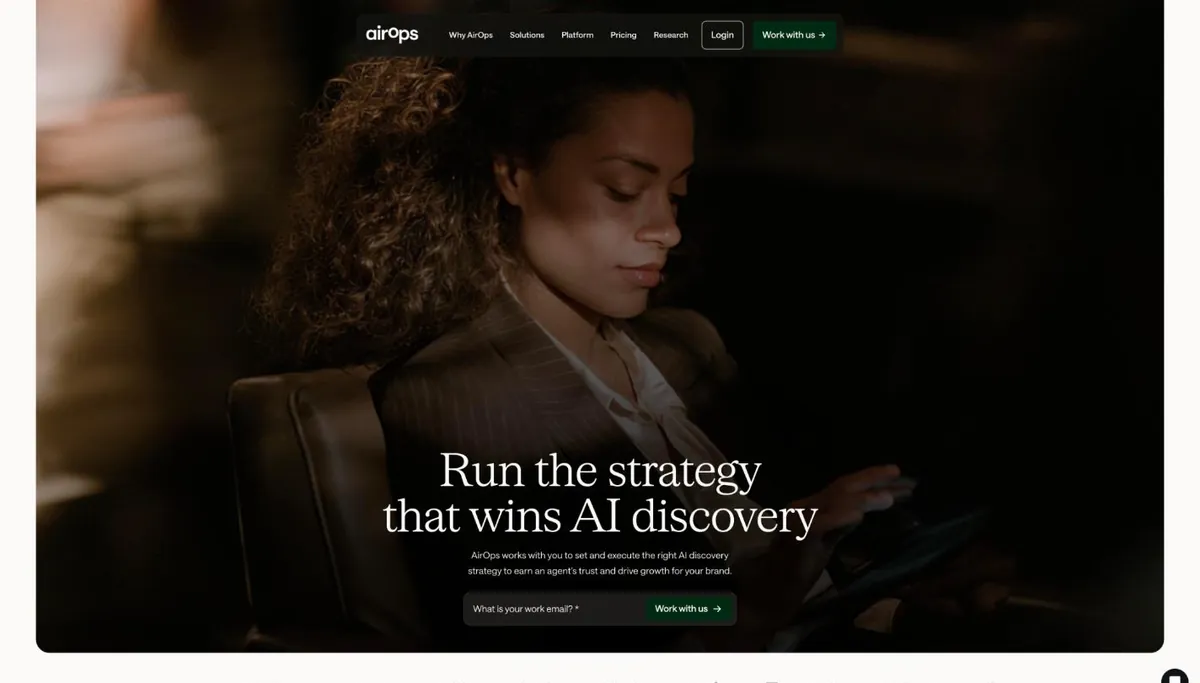
AirOps spans AEO monitoring and content production in one platform, which suits teams that want both functions under one roof, but the content it generates carries the same accuracy risk as any AI-first platform, and that risk is higher in cybersecurity than in most categories.
AirOps describes itself as “the growth platform for AI search.” It connects AEO visibility data to content production and performance tracking in one system, and it offers strategists and channel experts who can run programs for you.
Core capabilities: AEO visibility monitoring (tracks citations across ChatGPT, Perplexity, Gemini, and Google), multi-model support, content workflow automation, AI ads insights.
Tech expert-based: Partly. AirOps offers AI-search and marketing strategists, but not subject-matter writers in your technical domain. A team without practitioner expertise feeding poor inputs will get poor outputs at scale.
Human-led: Partial. Humans configure workflows and run tasks, and AirOps strategists can run programs; AI executes production. Subject-matter expertise and editorial judgment are not structurally embedded.
Price: A free Solo tier to start; Pro and Enterprise pricing isn’t published (third-party reviews report about $2,000/month for Pro).
Advantages: Genuine AEO monitoring plus content production in one platform; optional expert strategists; workflow automation reduces production overhead at volume.
Disadvantages: AirOps does not supply subject-matter expertise in your technical domain; it amplifies whatever inputs it receives. Not a fit for teams that need expert-grounded technical content without engineering that expertise into their own editorial inputs.
Jasper

Jasper is an AI content platform for marketing teams built around brand voice. Jasper IQ is the brand intelligence layer: Brand Voice, Style Guide, Knowledge Base, and Product IQ, applied at the moment of generation.
Jasper is a fit for marketing teams that need brand-consistent content at volume across general marketing channels, but context injection does not substitute for domain expertise when content must hold up in front of sophisticated target audiences such as cyber security professionals.
Core capabilities: AI-assisted content generation across formats (blog, landing pages, social, ads); Jasper IQ brand intelligence applied automatically across Canvas, Grid, and Agents; Research Agent for web-grounded retrieval (Business plan only); GEO Agent for AI visibility recommendations.
Tech expert-based: No. Generalist LLM-based generation with context injection. No structural practitioner involvement.
Human-led: Partial. Human configures brand context and reviews output; AI generates; judgment not structurally embedded.
Price: Pro $69/month or $59/year per user; Business custom pricing. Based on available information; confirm directly before procurement.
Advantages: Strong brand voice consistency across channels; accessible Pro pricing; Research Agent adds web-grounded retrieval for Business plan subscribers.
Disadvantages: Jasper IQ solves for voice and style drift. It does not solve for domain knowledge gaps. A detailed brief or product knowledge base does not substitute for practitioner expertise when content must hold up in front of sophisticated audiences such as cyber security professionals.
Growthx
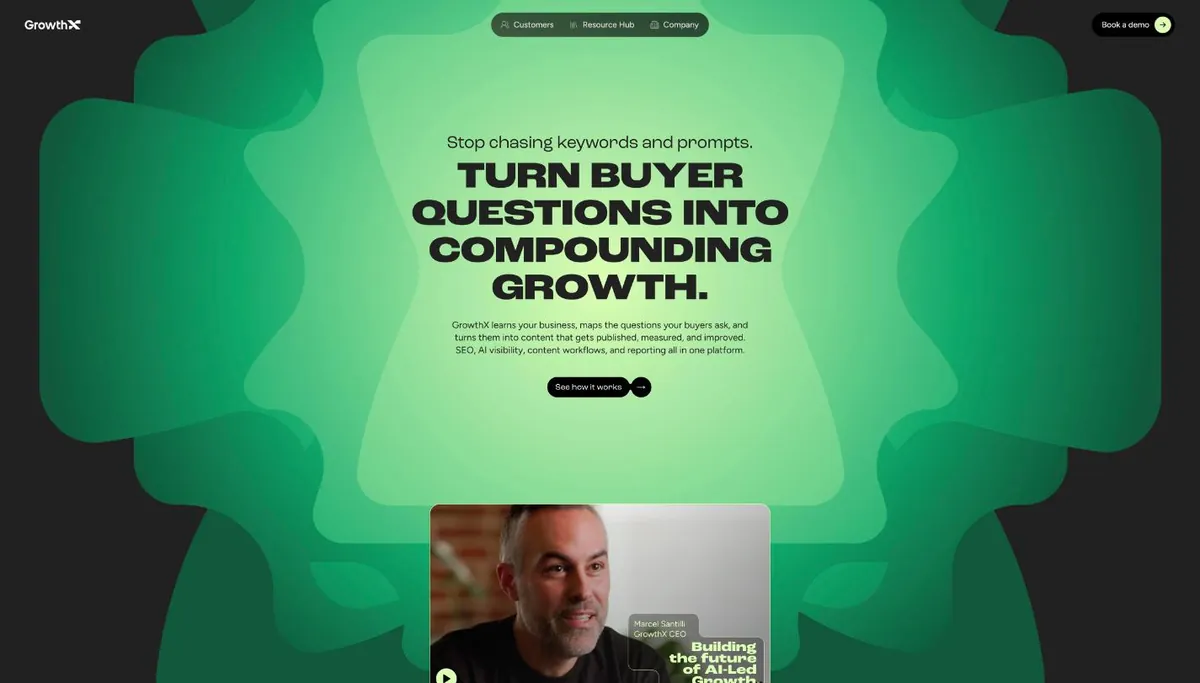
growthx.ai positions as an organic growth platform or an AI native managed service for SEO and AI visibility, with human marketers involved in client onboarding, but operational details that matter for procurement transparency are not confirmed from public sources.
Growthx calls itself “a system of growth for marketing” and an organic growth platform or an AI native managed service for SEO and AI visibility.
Core capabilities: Organic growth for SEO and AI visibility; specific feature breakdown not confirmed from public sources beyond this framing.
Tech expert-based: Based on first-hand observation, human marketers are structurally involved in onboarding and building strategic assets including brand context. The operational depth of that involvement across all content types is not confirmed from public sources.
Human-led: Partial, based on observed onboarding involvement. Full production model not confirmed from public sources.
Price: $5,000 to $20,000 per month, based on available information; confirm directly before procurement.
Advantages: SEO and AI visibility positioning; active product development; human involvement in onboarding adds a layer beyond pure automation.
Disadvantages: Insufficient public product information to evaluate fully against the five mandatory fields. The primary category- content generation, visibility monitoring, or something else- is not fully resolvable from public sources alone. Teams requiring full procurement transparency should engage the vendor directly before deciding.
Writer
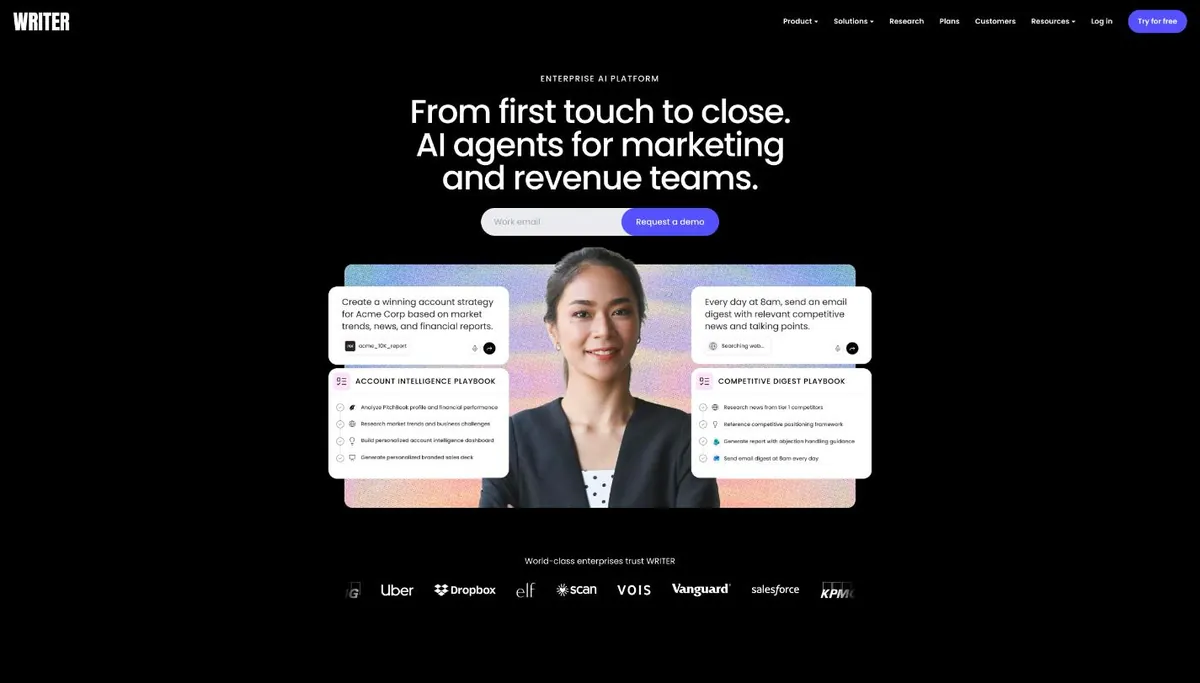
Writer is an enterprise AI content platform with a proprietary Palmyra LLM. Writer positions itself as “governed AI” for enterprise marketing teams, with AI agents capable of acting across enterprise workflows.
Writer is a strong option in this list for enterprise teams that need AI-governed content at scale with compliance and brand-consistency guardrails, however seems to lack the expert-grounded AI.
Core capabilities: Brand voice governance, compliance guardrails, AI agents (autonomous workflow execution), enterprise integrations, content generation across formats.
Tech expert-based: No. Enterprise governance layer over generalist LLM generation. No structural practitioner involvement in content production.
Human-led: Partial. Enterprise IT configuration defines guardrails; AI generates within them; human approval required for agentic actions.
Price: A self-serve Starter plan (up to five users, with a 14-day free trial; third parties report about $29–39 per user/month) plus custom-priced Enterprise. Verify against Writer’s current pricing page before procurement.
Advantages: Most mature enterprise governance architecture in the generation platform or an AI native managed service set; strong compliance and brand-voice consistency; AI agents reduce the time your team spends on high-volume workflows.
Disadvantages: Brand-voice and compliance configuration solves style and governance drift. It does not substitute for domain expertise when content covers specific product behavior, security controls, or architecture claims.
Profound AI
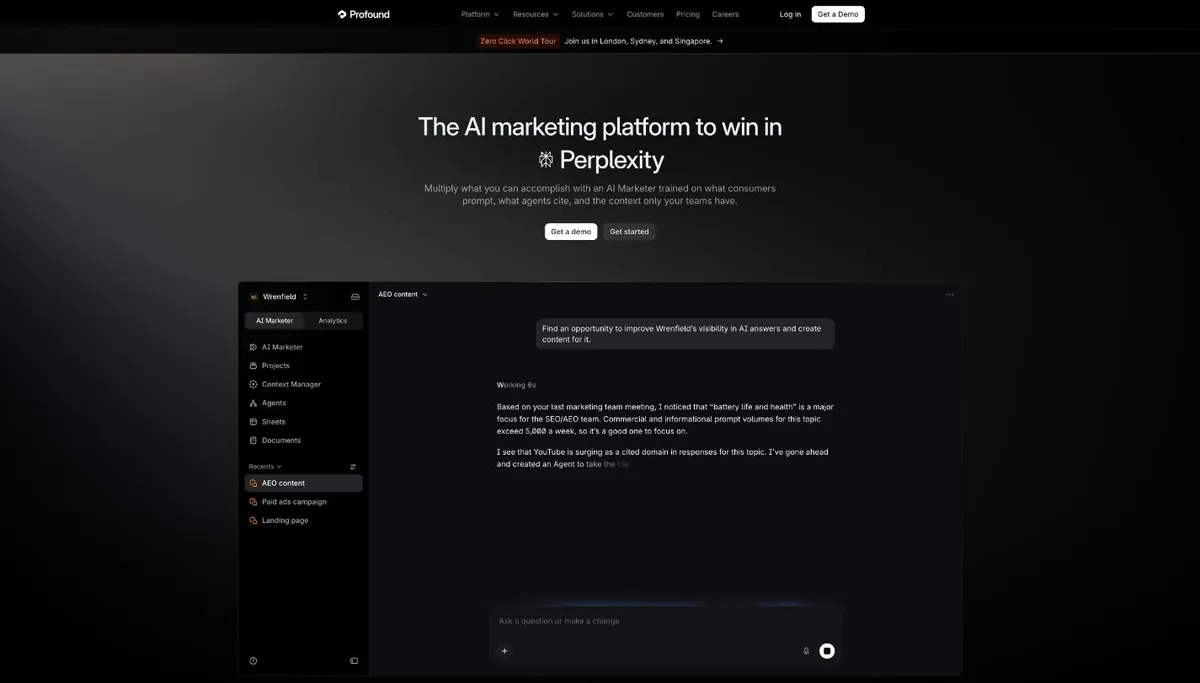
Profound AI started as the most capable enterprise AI visibility monitoring platform in this set and now also runs content agents that draft content and publish it after an approval step. Monitoring is still its core strength.
Profound AI is an AI visibility monitoring and AI marketing platform (the GEO/AEO monitoring category described above). Profound monitors brand mentions across ChatGPT, Perplexity, Google AI Overviews, and Gemini using real UI queries, not API calls, a distinction that produces more accurate monitoring than most alternatives. Profound describes its FactCheck feature as “the first way for brands to analyze AI accuracy at scale.”
Core capabilities: Answer Engine Insights (brand mention monitoring), AI Marketer (Aim) agent orchestration with an approval step before anything goes live, agents that generate drafts and content refreshes, Pages feature combining Search Visibility and AI Visibility.
Tech expert-based: No. Its content agents work from Profound’s visibility data and your context, not from domain practitioners.
Human-led: Partial. Agent runs include an approval step before anything publishes.
Price: A free 7-day trial (50 prompts; ChatGPT, Gemini, and Google AI Overviews); paid plans are custom-quoted through sales. Agencies have a self-serve Agency Growth plan with 400 agent credits per client workspace per month.
Advantages: Real-UI query methodology produces more accurate monitoring than API-based alternatives; FactCheck, Profound AI’s feature that tests whether AI models represent a brand’s products and claims accurately and flags errors at volume, which Profound calls the first brand AI accuracy analyzer at scale.
Disadvantages: Content production is newer than its monitoring core, and it doesn’t supply domain expertise for technical claims. Custom-quote enterprise pricing signals high TCO.
Peec.ai (AI visibility monitoring)
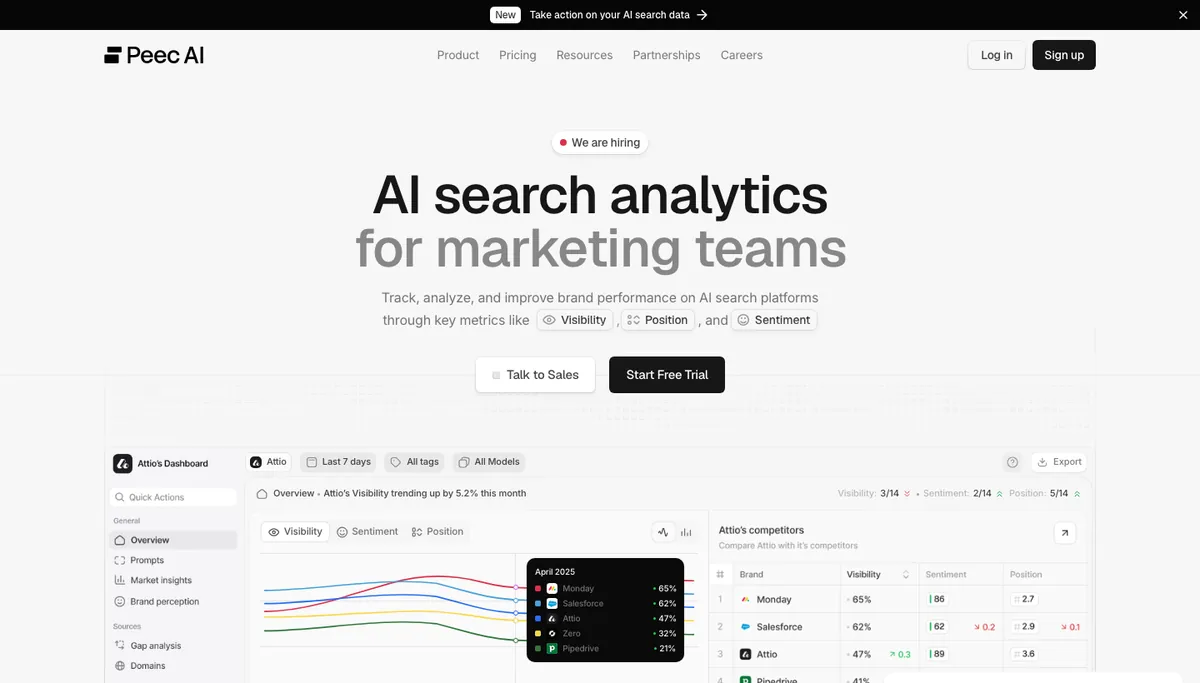
Peec.ai is an AI search analytics platform (the GEO/AEO monitoring category described above). Peec.ai runs prompts against ChatGPT, Gemini, Perplexity, Microsoft Copilot, and Google AI Overviews daily. Berlin-based, $21M Series A (November 2025).
Core capabilities: Daily prompt monitoring across four metrics (visibility, share of voice, position, sentiment), source distinction separating accessed sources from visibly cited links, competitor-only source gap analysis, MCP integration for pushing data into other platforms or AI native managed services, fanout-related search exposure tracking.
Tech expert-based: Not applicable; this is an AI visibility monitoring platform, not a content production platform or an AI native managed service.
Human-led: Not applicable in the content production sense; analytics platform or an AI native managed service with no content generation functionality.
Price: Starter $80/month (annual) or $95/month (monthly), 50 prompts, 3 models, 1 project; Pro $205/month (annual) or $245/month (monthly), 150 prompts, 2 projects; Advanced $420/month (annual) or $495/month (monthly), 350 prompts, 5 projects; Enterprise custom.
Advantages: Most transparent published pricing in the GEO/AEO monitoring category; daily monitoring provides trend-line data rather than one-off snapshots; MCP integration makes data portable across platforms or AI native managed services.
Disadvantages: Does not create content. Three-model cap per non-Enterprise plan tier limits coverage of smaller AI engines. Monitoring data alone identifies the visibility gap; it doesn’t close it.
Bonus Option: Homegrown AI Content Platform
Building on OpenAI or Anthropic APIs gives you flexibility and control over models, workflows, and brand context. But a production-ready system requires more than connecting prompts and automations.
GTM engineers can build useful workflows and proofs of concept with tools such as n8n. Maintaining reliable retrieval (RAG), product knowledge, AI context, technical accuracy, and editorial quality over time often requires deeper software and data engineering expertise.
Expert involvement: Entirely dependent on your team. APIs do not supply practitioner knowledge, and human review must be designed into the workflow.
Cost and trade-offs: No vendor license, but budget for API usage, engineering, maintenance, and quality control. The main benefit is customization; the main risk is turning a working demo into a dependable publishing operation.
How to Choose Between AI-Native Platforms and Managed Services
Start by distinguishing between AI-native platforms that your team operates independently and managed services that handle content strategy, production, and delivery.
The next step is to look for providers that combine both: specialized managed services with deep expertise in your technical domain, supported by an AI-native platform that enables reliable, responsible content production at scale.
This combination should support your broader GTM goals, including demand generation, product marketing, and customer engagement, while improving visibility across traditional search and AI-powered discovery (SEO, GEO, and AEO).
IOD is one example of this integrated approach, combining technical subject-matter experts, fully managed content production, and its proprietary Stesh AI platform.
IOD combines expert-led content strategy and production services with its proprietary AI-native platform to help technology brands build and scale their content operations.
[ FAQ ]
Frequently Asked Questions
What is the difference between an AI-native content platform and a managed service?
An AI-native platform is software your team operates on its own: you configure it, run it, and review its output. A managed service handles content strategy, production, and delivery for you. Some providers combine both, pairing experts in your technical domain with an AI-native platform.
Why is technical content harder for AI to produce?
AI can invent product features or technical claims that sound convincing but are wrong, and it can lose consistency over a long technical article. That pushes verification onto your SMEs and PMMs. Accurate, up-to-date product knowledge and early expert involvement are what keep technical content reliable.
When should experts be involved in AI content production?
Early, from research and outlining through final approval. When experts only review the finished draft, they become a bottleneck and revisions pile up; involving them upstream reduces rework and improves quality.
Should we build a homegrown AI content platform?
Building on OpenAI or Anthropic APIs gives you flexibility and control, and GTM engineers can build useful workflows and proofs of concept. Keeping retrieval, product knowledge, technical accuracy, and editorial quality reliable over time usually takes deeper software and data engineering, plus human review designed into the workflow.
How do I choose between AI-native platforms and managed services?
Start by deciding whether your team will operate the platform itself or needs a service that owns strategy, production, and delivery. Then look for a provider that combines deep expertise in your technical domain with an AI-native platform, and that supports your broader GTM goals and visibility across search and AI-powered discovery.