[ TL;DR ]
Key takeaways
- Keeping GTM aligned with innovation: Cybersecurity companies need partners who turn frequent product releases and complex technologies into timely, credible messaging and content.
- Five agency categories, all requiring SMEs: Expert-led content, SEO/GEO/AEO, performance marketing, branding, and individual writers serve different needs, while technical expertise strengthens every model.
- Technical expertise protects credibility: AI accelerates production, but expert input helps prevent inaccurate claims, generic messaging, and content that fails to engage security practitioners.
- Evaluate AI capabilities and flexibility: Compare proprietary platforms with point tools, self-service with managed delivery, and responsible AI practices that protect confidential product data.
- A practical buyer’s guide: We explain the best fit for each category and reference 14 well-known agencies and six individual cybersecurity writers to help you evaluate potential partners.
I’ve spent the past 15 years working in go-to-market for cloud and cybersecurity companies. Having founded IOD Cloud Technologies Research in Tel Aviv in 2017, I’ve had a front-row seat to the growth of Israel’s technology ecosystem and the evolution of how cybersecurity vendors bring new products to market.
From Check Point, which helped define the modern firewall market, to Google’s $32 billion acquisition of Wiz, Israel has consistently produced companies that have shaped cybersecurity.
And the momentum continues. In 2026, Oak emerged with $60 million in funding for AI-native identity security; Venice Security announced $33 million for privileged access management; Cyera raised $600 million at a $12 billion valuation; and Onyx Security launched with $40 million to secure enterprise AI agents.
For these cybersecurity companies, the challenge is keeping GTM (go-to-market) execution aligned with the pace of product innovation. Engineering teams constantly introduce new cyber capabilities and approaches to emerging threats. Meanwhile, marketing teams must keep up with campaign execution and content publishing at the same pace.
Marketing agencies play an important role in supporting cyber companies’ GTM efforts, from strategy and technical content production to SEO, GEO, demand generation, and creative campaigns. Each agency brings different expertise and production capabilities, shaping the quality and business impact of the services it delivers.
Understanding the Five Categories of Content and GTM Agencies for Cyber Companies
Many agencies offer services across several categories, and the relevant distinction is how they approach content creation and the expertise they bring to the process.
Category 1: PMM and Expert-Led Content Production Agencies
These agencies combine product marketing, technical subject matter experts (SMEs), research, and structured content production to help technology companies communicate complex cybersecurity approaches, products and their value.
Their work typically includes long-form technical articles, e-books, cheat sheets, white papers, technical research and benchmark reports, product comparisons, sales enablement materials, and thought leadership content. These assets support product launches, demand generation campaigns, competitive positioning, and ongoing market education.
Production begins with an understanding of the different audiences’ challenges, the product, its technical architecture, and the competitive landscape. Experienced cyber practitioners contribute technical insights, challenge product claims, identify differentiation, and help translate complex concepts into messaging that resonates with professional buyers from CISOs to security engineers and SOC analysts.
IOD Cloud Technologies Research (for cybersecurity companies), CyberEdge Group, HackerContent.
Technology companies requiring ongoing expert-led content, heavy technical research, sales enablement, and content production, reducing the workload on product marketing managers (PMMs), supporting product innovation and campaign execution (e.g., lead generation).
Category 2: SEO, GEO, and AEO B2B Agencies
These agencies specialize in increasing visibility across traditional search engines (e.g., Google, Bing), AI-powered discovery platforms and answer engines such as ChatGPT and Gemini (i.e., LLM visibility).
Their content production is driven by keyword research, search intent, topic clusters, competitive analysis, and opportunities to improve rankings and AI citations. They produce volumes of blog content, pillar and topic pages, FAQs, and comparison content designed to capture relevant search demand and target audience prompts.
Most agencies in this category serve a broad range of B2B industries, with some specializing in technology companies. Cybersecurity remains a niche within this category, requiring deeper knowledge of security architectures, evolving threats, and highly technical audiences.
Many have adopted AI-driven production systems that accelerate research, drafting, optimization, and publishing.
Platforms such as AirOps and Profound, alongside internally developed AI systems, can support content production, optimization, and AI visibility monitoring.
Platforms such as AirOps and Profound or homegrown AI systems can significantly increase output and help brands expand their presence across search and LLMs. However, AI-generated content introduces a significant risk: polished articles can present inaccurate technical information, unsupported claims, and generic messaging with convincing authority. At scale, and over time, these can undermine credibility with technical audiences and create longer-term search performance risks.
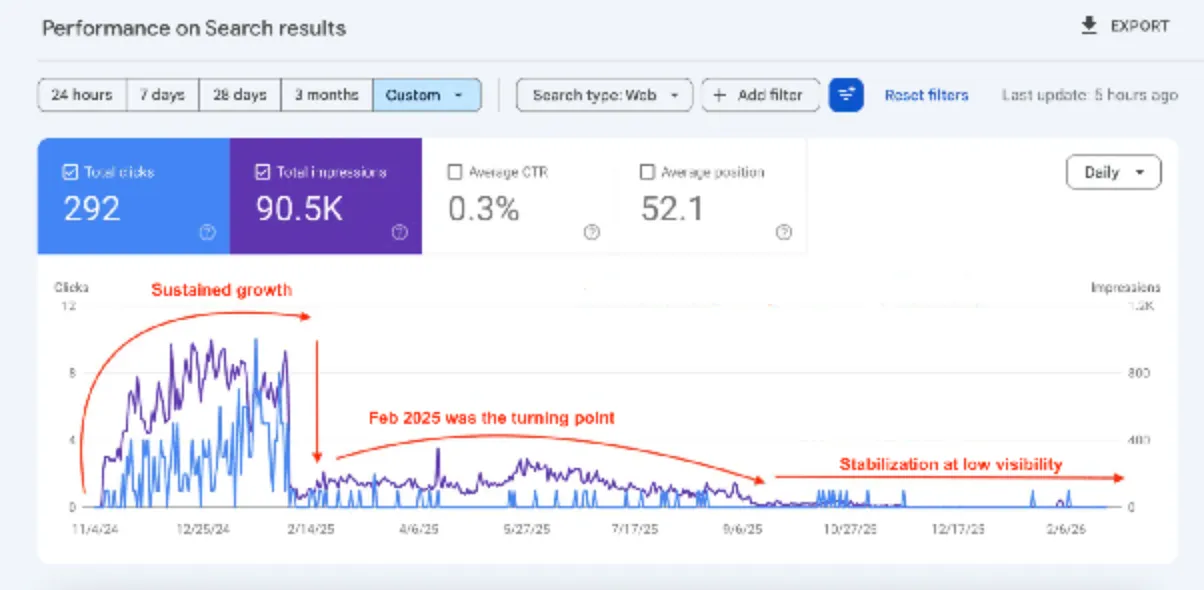
A 16-month experiment published by Search Engine Land followed 2,000 AI-generated articles and found that initial rankings declined sharply within three to six months. This illustrates the risks of relying on automated content volume without sufficient originality, demonstrated expertise, and ongoing quality control.
GEO and AEO extend into professional communities such as Reddit, LinkedIn, and industry forums, where real-world discussions influence AI-generated answers, brand perceptions, and purchasing decisions. Building visibility in these communities requires technical expertise, credible participation, and the ability to contribute meaningful insights to real conversations.
IOD Cloud Technologies Research, Airfleet, Agile SEO (Agile), KeyScouts, Animalz, GrowthX.
Companies prioritizing organic search, AI discoverability, and ongoing optimization, supported by reliable product knowledge and technical validation.
Category 3: Performance and B2B Marketing Agencies
These agencies specialize in demand generation, account-based marketing, paid media, marketing automation, social media marketing, influencer marketing, and campaign execution.
Content supports these activities through landing pages, email sequences, advertising copy, downloadable assets, social messaging and promotional articles designed to reach specific buyers and generate sales pipeline.
Social media and influencer marketing add another layer to campaign execution, particularly across LinkedIn and professional cyber communities. Effective engagement requires an understanding of technical audiences, from developing credible messages to responding to questions and participating in discussions.
Marketing professionals and copywriters typically lead content production, applying their knowledge of campaigns, conversion, and audience targeting. Cybersecurity SMEs can strengthen the process by contributing product knowledge and helping shape messages for professional cyber audiences.
Envy Marketing, IOD Cloud Technologies Research, Xtra Mile, Sage Marketing, Inspired Marketing.
Companies seeking campaign execution, demand generation, marketing operations, and multichannel distribution. Evaluate the agency’s ability to reach cybersecurity audiences and develop messaging that resonates with them.
Category 4: Branding and Creative Agencies
Branding agencies focus on positioning, visual identity, messaging strategy, creative campaigns, and website experiences.
Their content supports brand storytelling through homepage copy, product narratives, campaign concepts, presentations, and launch materials.
These agencies help technology companies communicate complex ideas, develop differentiated positioning, and establish a recognizable market identity. Involving technical specialists during positioning and messaging development can reveal additional product advantages and strengthen the connection to buyer needs.
Brand development, positioning, creative campaigns, website redesigns, and major product launches.
Category 5: Individual Technical Writers and Cybersecurity Practitioners
Independent cybersecurity writers offer a personal, hands-on approach, combining writing experience, direct collaboration, and familiarity with the cybersecurity industry. Experienced writers can translate complex topics into accessible, engaging content while maintaining a consistent voice and adapting to a company’s messaging.
However, professional writing experience does not necessarily translate into hands-on cybersecurity expertise. While some writers have worked as security engineers, SOC analysts, or cloud architects, others rely primarily on research and interviews with subject matter experts. This distinction becomes particularly important when covering emerging technologies, complex architectures, or innovative security products that require deeper technical understanding.
Scalability is another limitation. Individual freelancers typically focus on research and writing, leaving internal marketing teams responsible for editorial reviews, technical validation, SEO/GEO optimization, design, planning, and publishing. Their availability and capacity can also constrain larger content programs.
- US-based writers: Vina Nguyen, Rodika Tollefson, and Bret Staton.
- Israel-based writers: Andrey Pautov, Gedalyah Reback, and Jonathan Gold.
Ad hoc writing assignments, one-off technical articles, specialized content projects, and smaller ongoing programs where internal marketing teams can manage editorial quality, technical validation, and distribution.
These professionals bring different combinations of technical knowledge, industry familiarity, and writing experience. Their specific areas of expertise and hands-on backgrounds should be evaluated individually.
AI-Enabled Agencies: Tools, Platforms, and Flexible Delivery
AI capabilities are a fundamental requirement when choosing a content agency. The question is how the agency uses AI, how deeply it’s integrated into production, and whether its AI systems also create value for the cyber brand it serves.
Some agencies combine point solutions and internal AI workflows, leveraging models such as Claude and web-data tools such as Bright Data for research, drafting, SEO optimization, and content management. Only a few have developed proprietary software and AI systems to improve production efficiency, maintain brand consistency, and streamline delivery.
Looking into 2027, a more interesting and advanced model is emerging with companies such as IOD Cloud Technologies Research and GrowthX, which combine AI-enabled production with managed services. This approach can give clients access to technology as part of the engagement, allowing their internal teams to participate directly in research, campaign execution, content creation and collaboration.
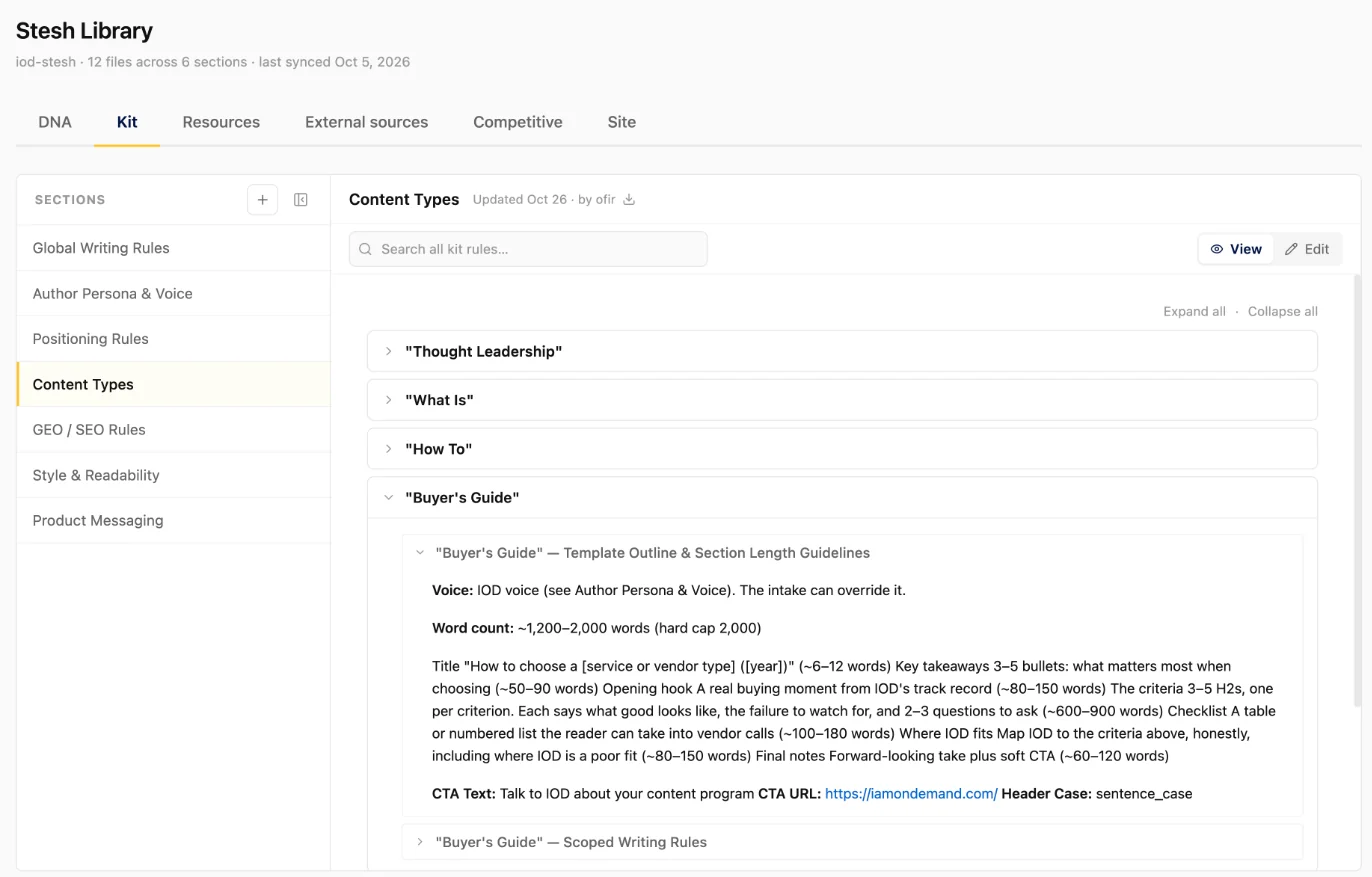
At IOD, we offer three delivery models: fully managed service, a hybrid model or self-service through Stesh.ai (see below screenshot), our AI-platform. The hybrid model enables client marketing and PMM teams to collaborate directly with IOD’s cybersecurity experts, using the same platform and production workflows.
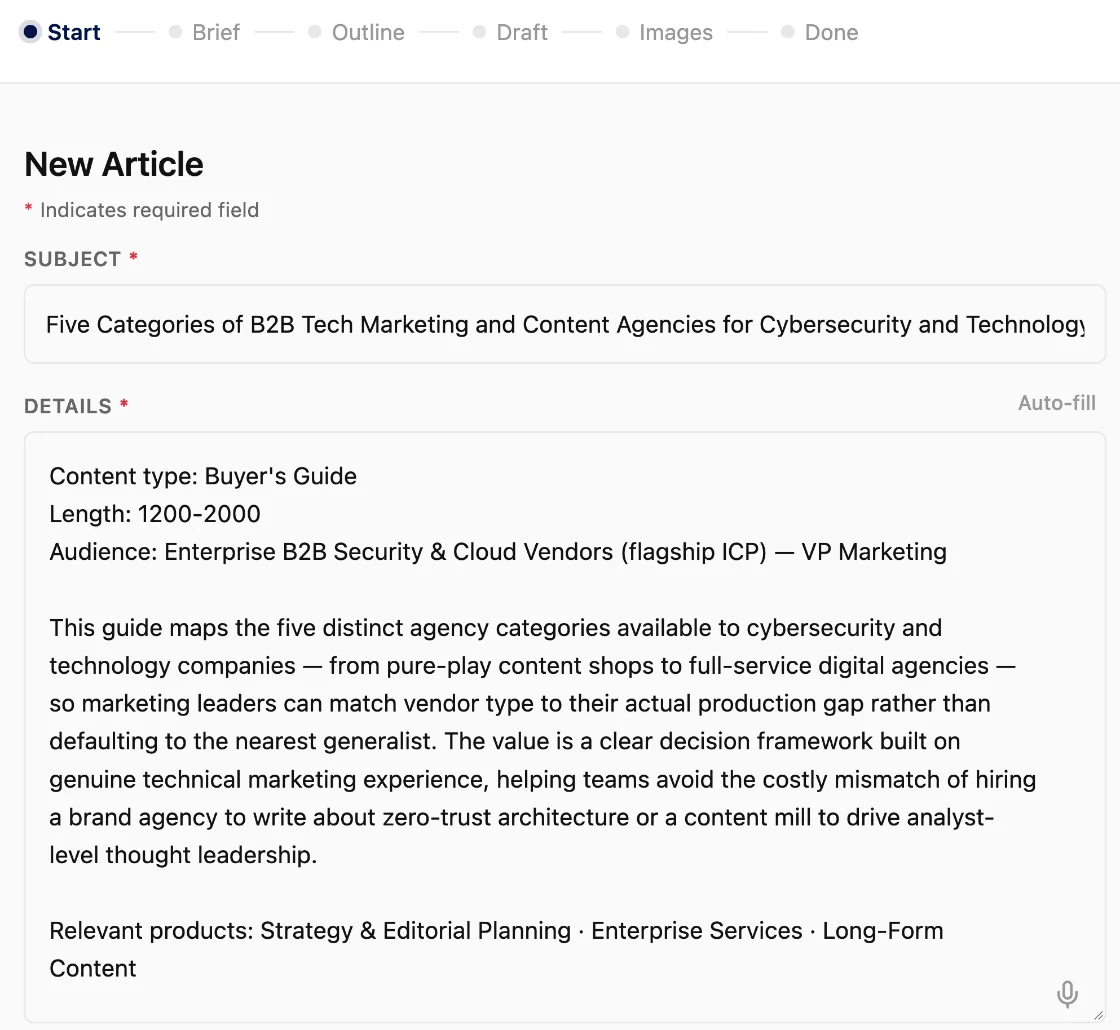
When evaluating an agency, cyber and tech marketers should ask whether its AI capabilities are used exclusively by its internal team or whether your organization can also use them. Can your PMMs create briefs, contribute research, collaborate with experts, and manage revisions directly? Can the engagement evolve between self-service and managed delivery as your needs change?
Finally, responsible AI usage should be part of the evaluation. Agencies need clear policies for data privacy, intellectual property, access permissions, confidential product information, and the use of client data by third-party AI providers.
The goal is to work with an agency whose AI capabilities improve production quality, preserve your organization’s knowledge, and provide flexibility as your GTM needs evolve.
Final Note: Every Category Needs Cybersecurity Subject Matter Experts
After years of working with technology companies, one conclusion stands out to me: regardless of which agency category you choose, subject matter experts should be involved in content production.
There are several sources of expertise.
- Your R&D and product teams understand the architecture, technical decisions, and product differentiation.
- Your customers understand how the technology performs in real environments, which problems matter, and what makes a solution valuable.
- Your product marketing managers should serve as researchers and facilitators, connecting product knowledge, customer conversations, competitive intelligence, and market requirements into coherent messaging.
- Your agency’s own technical experts can contribute an additional perspective informed by professional experience in your target market.
Imagine working with professionals who represent your intended readers: cloud security architects, threat researchers, SOC analysts, AppSec engineers, DevSecOps practitioners, AI security specialists, data security professionals, or identity and access management experts.
These professionals can challenge assumptions, introduce ideas, suggest competitive distinctions, and help develop content that resonates with technical buyers. This becomes particularly valuable for emerging technologies, where important product innovations may have little coverage in publicly available research or LLM knowledge.
Ultimately, I’d evaluate a content agency by how effectively it combines its marketing capabilities, production processes, and real technical expertise. For cybersecurity and other complex technology companies, that combination is what turns content production into a meaningful part of the GTM engine.
[ FAQ ]
Frequently Asked Questions
What are the best content marketing agencies for cybersecurity companies?
Leading options include IOD Cloud Technologies Research, CyberEdge Group, HackerContent, Airfleet, Agile SEO, and GrowthX. The best choice depends on technical expertise, content needs, and SEO/GEO/AEO capabilities.
What are the main categories of marketing agencies for cybersecurity companies?
Five categories: expert-led content production, SEO/GEO/AEO, performance marketing, branding and creative, and individual technical writers. Agencies may operate across multiple categories.
How are expert-led cybersecurity content agencies different from SEO and GEO agencies?
Expert-led agencies prioritize technical knowledge, product positioning, and practitioner insights. SEO/GEO agencies focus on search visibility, optimization, and discoverability. Both capabilities complement each other.
Why are subject matter experts important for cybersecurity content marketing?
SMEs validate technical claims, contribute original insights, strengthen positioning, and ensure content resonates with security professionals and technical buyers.
What AI capabilities should a cybersecurity content agency provide?
Look for AI-assisted research, brand knowledge management, content production, and optimization, alongside data protection and flexible self-service, hybrid, or managed delivery.
Should a cybersecurity company hire independent technical writers or a content agency?
Independent writers suit specialized projects and thought leadership. Agencies provide managed production, editorial coordination, technical reviews, optimization, and scalability.
How much does a cybersecurity content marketing agency cost?
Pricing depends on content complexity, expert involvement, production volume, and delivery model. Compare per-asset fees, retainers, and platform subscriptions, including technical review and revisions.