Originally published · Updated
[ TL;DR ]
Key takeaways
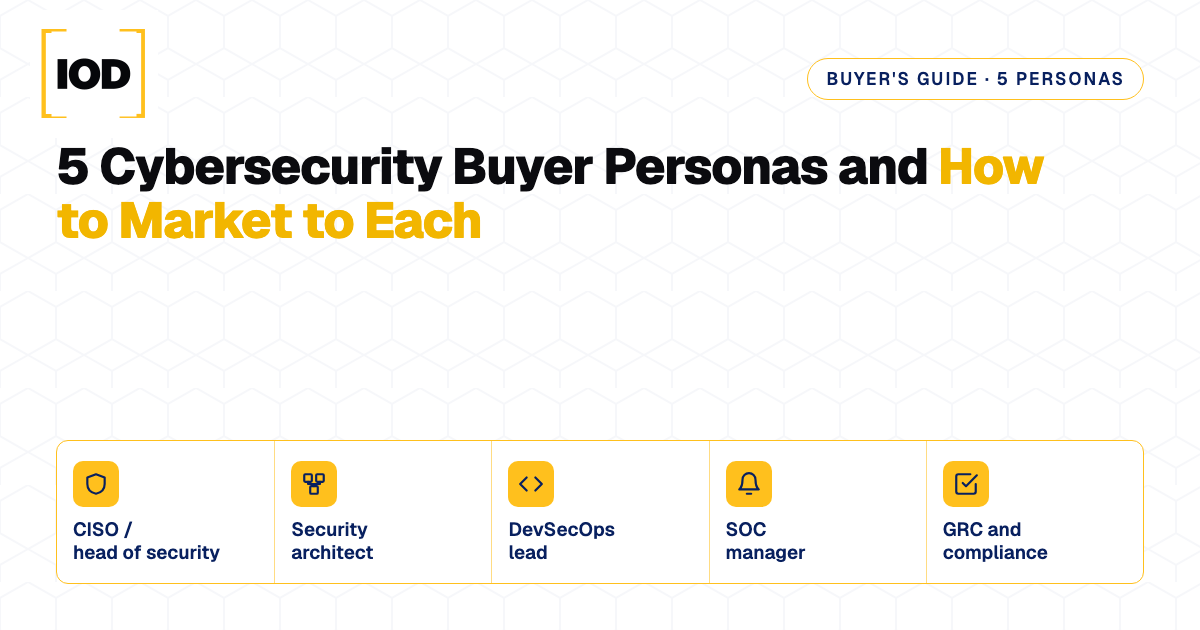
- CISO / head of security: Decides and owns the budget. Give them peer case studies and cost evidence they can take to the board.
- Security architect / IAM or cloud security lead: Often evaluates first and champions the tool internally. Win them with integration guides and a POC they can run.
- DevSecOps / platform engineering lead: Can block adoption if a tool slows the pipeline. Show runnable CI/CD examples and false-positive benchmarks.
- SOC / security operations manager: Uses the tool every day and shapes renewal. Prove it cuts alert noise without missing detections.
- GRC, risk and compliance lead: Checks the evidence and can hold up approval late in the deal. Have questionnaires and control mappings ready early.
A recent Reddit PMM community discussion shows how hard it is for PMMs to learn what each target persona actually needs. The challenge gets sharper in their own win/loss analysis, when they have to work out why a buyer chose them or walked away. This guide gives you a starting profile for each role, so your win/loss notes have something to test against.
This guide helps tech marketers at startups and enterprises plan content for each cybersecurity buying role. It’s for product marketing managers (PMMs), demand gen and content leads, VPs of Marketing, and CMOs, plus founders choosing their first assets.
| Persona | Buying role | #1 challenge today | Main question they ask | Best content format | Funnel stage |
|---|---|---|---|---|---|
| CISO | Decides | AI governance without proportional resources | “What does this do for my risk posture?” | Executive brief, peer case study | Top and mid |
| Security Architect | Evaluates and champions | Non-human identity sprawl and deployment model selection | “Will this integrate and can I run the proof of concept (POC)?” | Architecture deep dive, integration guide | Top and mid |
| DevSecOps Lead | Evaluates adoption and influences selection | False positives and pipeline friction | “Will this break our CI/CD?” | Tutorial, hands-on lab, GitHub example | Top and mid |
| SOC Manager | Uses and influences renewal | Alert fatigue in security operations and staffing gaps | “Does this reduce noise or add to it?” | Playbook, benchmark report, case study | Top and mid |
| GRC and Compliance Lead | Approves and gates | Regulatory burden and audit evidence gaps | “Can you give me the compliance mapping?” | Compliance doc, total cost of ownership (TCO) calculator, vendor questionnaire | Mid to late |
What changed in cloud-native security buying?
These five shifts change what your content needs to prove during evaluation.
Leaner teams with overlapping roles
The 2025 ISC2 Cybersecurity Workforce Study surveyed 16,029 respondents. It found that 95% report at least one cybersecurity skills need, and 59% rate that need as critical or significant. Give lean teams reusable evaluation packs and evidence templates.
Product-led and developer-first evaluation
Practitioners evaluate tools before the CISO or procurement engages. Make evaluation materials accessible without requiring an executive introduction.
Platform consolidation pressure
Nearly 70% of respondents had consolidated or were consolidating onto platforms. The IANS/Artico 2025 Security Software and Services Benchmark surveyed 628 security executives. Help buyers compare integrations and costs.
AI tools and agents in the security stack
AI coding assistants, agents, and detection tools raise questions about permissions, model access, and validation evidence.
AI assistants in buyer research
Buyers may research through AI assistants, which can misstate vendor positioning. Publish clear, sourced product facts through original, practitioner-authored content that buyers can verify.
Who sits on a cybersecurity buying committee?
Job titles alone won’t tell you who can advance or stop a deal. Map the responsibilities within each account.
The Forrester State of Business Buying 2024 found an average of 13 internal participants in general B2B purchases. These benchmarks cover general B2B buying and don’t establish cybersecurity committee size.
Linx Security, an IOD client, provides AI-native identity security and governance, with a demo-led, 30–60-day proof-of-value. Its example buying committee includes the CISO, IAM engineering lead, CIO/CTO, security engineers and GRC. Venice Security, another IOD client, provides privileged access management (PAM) for hybrid estates and AI agents, with the VP of IAM as economic buyer. In its example committee, IAM engineers or architects read first and champion the product. Project teams, auditors, procurement and end users can hold up the deal.
The CISO / head of security
“Legacy IGA can be overwhelming in both cost and effort resulting in diminishing or even negative ROI.”
Jeff Farinich, SVP Technology & CISO, New American Funding (a Linx Security customer) (source)
Give the CISO (chief information security officer) material they can take into a budget discussion. The IANS/Artico 2026 Security Budget Benchmark of more than 500 security executives found 5% average growth, with 45% reporting flat budgets.
- Titles and org placement. CISO, VP of Security, Head of Security. Startup reporting: CEO or CTO. Enterprise reporting: CRO, COO, or board. At smaller companies, the CISO often also handles GRC.
- Ownership and KPIs. Security strategy, risk posture, budget efficiency, incident readiness, consolidation, and compliance.
- 2026 challenges. AI governance without matching resources, budget scrutiny, consolidation pressure, board alignment, and regulatory scope. Board concerns include operational disruption, data loss, and reputational risk.
- Buying role and budget authority. Decides, with delegated authority or shared finance approval. Usually needs the architect’s recommendation and GRC sign-off.
- Buying triggers. Breach, regulation, board mandate, M&A due diligence, incoming CISO, or a funding round changing compliance requirements.
- Objections and proof needed. “We already have too many licenses.” Provide a named peer case, TCO comparison, and quantified ROI. Named CISO references and analyst coverage help this buyer evaluate your claims.
- Research channels. CISO networks, RSAC, Gartner Security and Risk Summit, IANS briefings, LinkedIn, and AI assistants.
- Content formats. Executive briefs, peer-quoted case studies, board-ready risk reports, and ROI calculators. CISOs ignore feature documentation and statistics without business context.
- Messaging. “Compare consolidation costs and documented risk changes before your next board review.” Use risk posture, compliance readiness, consolidation, blast radius, and board-level visibility. Answer “what does this mean for my risk posture?”
- Funnel entry and stage needs. Top: trends and board-reporting frameworks. Mid: peer cases and analyst validation. Bottom: ROI, TCO, and proof-of-value support.
The security architect / IAM or cloud security lead
“We needed to determine what guardrails would enable them to deploy securely.”
Andrew McKenna, Cloud Security Architect, Priceline (source)
The security architect typically reads before the CISO, runs the POC, and shapes the technical recommendation.
- Titles and org placement. Security Architect, Cloud Security Architect, IAM or Cloud Security Lead. Startup IAM engineers may report to the CISO or CTO. Enterprises split specialist responsibilities across identity, network, and cloud teams.
- Ownership and KPIs. Sound architecture, successful POCs, integration coverage, complete identity governance, and audit-ready technical controls.
- 2026 challenges. Non-human identity (NHI) sprawl, deployment choices, growing attack surfaces, integration complexity, and explaining architecture decisions to the board. CNAPP (cloud-native application protection platform) evaluation weighs agentless versus agent-based coverage and overhead. NHI includes service accounts, API keys, machine identities, and AI agents.
- Buying role and budget authority. Evaluates and champions, rarely with direct budget. Venice Security’s IAM engineer “owns the exception list, approves the tickets, and gets the 2 a.m. page.”
- Buying triggers. Cloud migration, new category evaluation, failed incumbent POC, or a new CISO’s evaluation mandate. Category evaluations include CNAPP, NHI governance, and PAM for AI agents.
- Objections and proof needed. “I don’t know if this fits our IdP and SIEM.” Supply tested API coverage, a stack-specific configuration guide, and a comparable customer reference. Map the identity provider (IdP), security information and event management (SIEM), and cloud provider APIs. Include SOAR (security orchestration, automation and response) in the integration assessment.
- Research channels. Vendor docs, GitHub, Stack Overflow, Black Hat, DEF CON, technical newsletters, and peer communities. Architects use AI assistants to compare deployment options and integration documentation.
- Content formats. Architecture deep dives, integration guides, API documentation, labs, and technical comparisons. Architects ignore executive briefs and feature lists without architecture context.
- Messaging. “Test the documented integrations in your environment and record deployment requirements.” Use integration coverage, deployment model, API surface, blast radius, and agentless. Avoid “industry-leading identity security platform” without technical proof.
- Funnel entry and stage needs. Top: architecture guides. Mid: POC documentation and integration evidence. Bottom: architecture validation and comparable customer contacts.
The DevSecOps / platform engineering lead
“Wiz made risk management easier and more tangible for our developers.”
Julian Suttner, Senior Engineering Manager – Platform Engineering & Scalability Engineering, Scalable Capital (source)
The DevSecOps lead can refuse adoption after the CISO signs. Show what changes for the developer maintaining a build.
- Titles and org placement. DevSecOps Engineer, Platform Engineer, AppSec Lead. Startup reporting: engineering lead or CTO. Enterprise reporting: VP of Engineering or Head of Platform.
- Ownership and KPIs. Deployment velocity, false-positive rate, CI/CD (continuous integration and continuous delivery) health, IaC (infrastructure-as-code) coverage, developer experience, and remediation time.
- 2026 challenges. False positives, AI-assisted code review, IaC enforcement, Kubernetes security, and proving ROI in developer productivity terms. Policy enforcement spans Terraform configurations, Kubernetes manifests, and multiple product teams. Teams need tools that run without manual work. False positives erode developer trust in security tools.
- Buying role and budget authority. Evaluates adoption and influences selection, usually without direct budget. Platform purchases vary.
- Buying triggers. Pipeline disruption, poor developer experience, a new cloud-native stack, or a shift-left mandate.
- Objections and proof needed. “This will slow down our pipeline.” Supply runnable CI/CD examples and false-positive benchmarks.
- Research channels. Reddit, Hacker News, KubeCon, AWS re:Inforce, YouTube, GitHub, and AI assistants. Relevant Reddit communities include r/devops, r/netsec, and r/kubernetes.
- Content formats. Working tutorials, GitHub examples, evaluation materials, and pipeline-impact benchmarks. DevSecOps leads ignore executive briefs and feature lists without CI/CD examples.
- Messaging. “Run it on one repo for a week and compare findings with your current scanner.” Use pipeline friction and developer experience. Avoid “comprehensive application security” without false-positive evidence or a CI/CD example.
- Funnel entry and stage needs. Top: tutorials and community discussion. Mid: POC with pipeline integration. Bottom: onboarding guides and an escalation path to vendor engineering.
The SOC / security operations manager
“The main benefit was centralizing everything into one product, which allowed us to detect and address threats and issues more efficiently.”
James Collinson, Security Operations Manager, Matillion (source)
Write for the analyst handoff within the SOC (security operations center). Your runbook needs to work for the next shift.
- Titles and org placement. SOC Manager, Security Operations Manager, Detection and Response Lead. Startups may combine this role with senior analyst duties. Enterprise managers report to the CISO or VP of Security Operations.
- Ownership and KPIs. Mean time to detect (MTTD), mean time to respond (MTTR), alert-to-ticket ratio, automation coverage, analyst utilization, and false positives.
- 2026 challenges. The Splunk State of Security 2025 surveyed 2,058 security leaders. It found 59% report too many alerts and 55% report too many false positives. Staffing gaps, AI-triage trust, automation ROI, and SIEM replacement add pressure. New detection tools must integrate without disrupting active investigations. Analyst trust can suffer when AI recommendations conflict with analyst instincts.
- Buying role and budget authority. Uses the tool and influences renewal and expansion, usually without direct budget.
- Buying triggers. SIEM replacement, staffing crisis, new detection requirements, acquisition, or alert spikes overwhelming triage.
- Objections and proof needed. “We’ve tried tools that promised to cut alert noise and made it worse.” Replay labeled alerts to show missed detections and escalation criteria alongside noise reduction.
- Research channels. Detection engineering communities, SANS, SOC summits, peer referrals, and practitioner conferences. SOC leads may use AI assistants to summarize threat intelligence.
- Content formats. Playbooks, runbooks, benchmarks, named case studies, and detection rules. SOC managers ignore executive whitepapers and unattributed statistics.
- Messaging. “Test this triage workflow against your alert data and agreed detection criteria.” Use triage time, missed detections, escalation criteria, detection coverage, noise reduction, and alert fidelity. Avoid “AI-powered security operations” without verifiable results.
- Funnel entry and stage needs. Top: benchmarks and detection guides. Mid: proof-of-value with actual alerts. Bottom: renewal cases and vendor SOC escalation paths.
The GRC, risk and compliance lead
“Rogo is at a really interesting juxtaposition between customers being extremely highly regulated and conservative, while we’re an applied AI high-growth organization,”
Patrick O’Boyle, Founding security engineer and Head of GRC, Rogo (source)
The GRC (governance, risk and compliance) lead needs documents they can trace to a source. Make the issuer, date, and scope easy to find.
- Titles and org placement. GRC Manager, Risk and Compliance Manager, VP of Risk, Head of Compliance. Startups may assign this to the CISO or legal counsel. Enterprise reporting: CFO, CRO, or CISO.
- Ownership and KPIs. Audit findings, remediation rate, framework coverage, vendor risk scores, evidence completeness, questionnaire response time, and TCO.
- 2026 challenges. Regulatory scope, AI governance ownership, questionnaire volume, investment ROI, and evidence gaps. Security, legal, and AI platform teams may lack clear ownership of AI incident response and exercises.
- Buying role and budget authority. Checks evidence and can hold up approval, without direct budget. Formal approval authority varies by organization.
- Buying triggers. Enforceable regulation, audit finding, M&A due diligence, or renewal with unresolved compliance gaps.
- Objections and proof needed. “I don’t have enough evidence to complete my assessment.” Provide a completed questionnaire and relevant compliance report. Match SOC 2 Type II evidence or ISO 27001 certification to the customer’s requirement. A SOC 2 Type II report independently audits a vendor’s security controls over time. Product mapping documents don’t certify NIS2 or DORA compliance. Show which obligation each document addresses.
- Research channels. Compliance newsletters, legal advisories, regulatory texts, procurement databases, peer communities, and AI assistants.
- Content formats. Completed questionnaires, framework mappings, TCO templates, and audit evidence packages. GRC leads ignore feature marketing and benchmarks without compliance context.
- Messaging. “Review the completed questionnaire and applicable control evidence with your audit team.” Use audit evidence and control mapping. Support compliance claims with documentation and scope.
- Funnel entry and stage needs. Typically mid-to-late, after CISO and architect alignment. Mid: compliance documentation. Bottom: questionnaire responses, audit evidence, TCO, and contract review support.
Where cloud-native security personas agree and where they conflict
All five personas feel AI risk, budget scrutiny, and tool sprawl in 2026. Their priorities can still conflict.
Consolidation versus practitioner choice
The CISO’s consolidation mandate can conflict with DevSecOps preferences for best-of-breed tools. Build a shared evaluation plan covering technical outcomes, pipeline metrics, compliance evidence, costs, and integration and exit requirements.
Auditability versus adoption friction
GRC needs a clear audit trail, while DevSecOps needs tools developers can adopt easily. Provide an API coverage map or configuration guide with audit-trail outputs.
Alert reduction versus detection coverage
A low alert count can look good in a cost review while hiding a detection gap. Ask SOC and finance to agree on success criteria.
What startup founders should do first
Plan content around how buyers evaluate your product. Choose where to start before commissioning assets for all five personas.
Developer-first products
For CNAPP, AppSec, and shift-left tooling, start with the practitioner or architect. Publish a technical tutorial or architecture guide, followed by runnable evaluation proof. Then make the business case for executives and prepare a GRC evidence pack. Check who evaluates first because CNAPP purchases follow different paths. Executive awareness may take longer.
Platform plays
For consolidated identity, enterprise SecOps, and GRC automation, start with the CISO. Publish a business brief about risk and cost, then technical validation for architects and practitioners. Follow with compliance and TCO support for GRC and procurement.
The emerging sixth stakeholder: the AI and ML platform owner
The AI and ML infrastructure owner sometimes joins AI security evaluations. They test deployment fit, model and data access, and security controls, then work with security to approve implementation. This role isn’t standardized or interchangeable with a head of AI security. Confirm who owns AI infrastructure governance before assigning a buying role.
Where IOD fits
You need technically accurate content that reaches all five personas. Our practitioner experts direct the work, set the brief, and approve the outline before Stesh, IOD’s AI platform, drafts a word. They sign off before anything ships. IOD is the AI-native content agency for cybersecurity, cloud and AI infrastructure.
Our practitioner experts are CISOs, security architects, and DevSecOps, SOC and GRC practitioners. They are the audience you’re trying to reach and the personas in this guide. Their point of view gives you the strongest base for your go-to-market strategy and its execution. That’s where IOD’s content strategy services start.
We analyze the prompts these buyers run in AI assistants to guide generative engine optimization (GEO) and answer engine optimization (AEO). Our guide to GEO and AI search explains how buyer questions shape that work. Then we create the content and distribute it in communities where these personas talk, including Reddit and Discord.
Under our experts’ direction, Stesh also runs win/loss analysis and builds battle cards for clients. We use those findings and battle cards to keep each persona profile current as buyer objections and competitive choices change.
IOD’s content program for startups provides expert-led go-to-market support before every marketing role exists in-house. It includes launch content, practitioner subject matter experts, assets in multiple formats, and messaging alignment.
See IOD’s approach to content production and client results.
[ FAQ ]
Frequently Asked Questions
What is the biggest challenge in marketing to cybersecurity buyers?
Cybersecurity buying committees span several roles, and each needs different proof before supporting a purchase. Your content has to answer each role’s objections and help the committee agree on a decision.
Who is the main buyer of cybersecurity products?
The CISO often makes the purchase decision, with spending authority delegated or shared with finance. Architects and practitioners evaluate the product, while GRC and procurement can hold up approval. Confirm who controls the budget in each account.
What does a CISO want from security vendor content?
CISOs want evidence they can use to explain risk and spending decisions to the board. Give them named peer case studies, cost comparisons, and documented business outcomes.
What does a SOC manager need to see before buying a security tool?
SOC managers need evidence that a tool reduces alert noise without missing threats or disrupting investigations. Show labeled alert replays, integration details, and runbooks that explain escalation criteria and analyst handoffs.
What does a GRC or compliance lead want from a security vendor?
GRC and compliance leads need traceable evidence for vendor assessments and audits. Provide completed questionnaires, relevant compliance reports, and control mappings with clear issuers, dates, and scope. Match each document to the customer’s requirements.
How can I research what my target security persona needs?
Interview people in the target role, then review sales objections, win/loss notes, and community threads such as Reddit discussions. Run the persona’s likely prompts in ChatGPT, Gemini and Perplexity to see what answers and sources appear. Compare those answers with interview evidence before choosing content topics.
How can IOD help with cybersecurity persona marketing?
IOD’s practitioner experts are the CISOs, architects, DevSecOps, SOC and GRC practitioners your marketing targets. They direct strategy and content, with Stesh, IOD’s AI platform, drafting between expert approval steps. IOD analyzes buyer prompts for GEO and AEO, creates content, and distributes it in communities where these personas talk, including Reddit and Discord.