What 70,000 Engineers and 780 Marketers Taught Me About GTM in B2B Tech

I hesitated before bringing this up with Elinor, my wife. Talking about men and women as two sides of an industry doesn’t feel politically correct, especially in tech. But when I described my last two weeks, moving from AWS re:Invent, with 70,000 people and a room that was roughly 80% men, to a cybermarketing conference of about 780 people, where the ratio was almost reversed, she didn’t challenge the observation.

She said it wasn’t provocative, it was real. “If that’s what you keep seeing,” she told me, “then maybe that contrast is the story.” 

And the more I thought about it, the more I realized this wasn’t really about gender at all. It was about this gap I had covered and talked about for a good number of years: Two professional worlds that have grown apart, and a gap that should be bridged much faster. 

This article is for all tech GTM leaders.

If the Shoe Doesn’t Fit… the Engineer Won’t Wear It

A shoe. That’s what highlighted a gap that became impossible to ignore. When I founded IOD, I saw a company selling advanced analytics publish a deeply technical blog post, clearly aimed at data engineers. But the article feature image was of a high-heeled shoe. 

Nothing about the product, the problem, or the audience was reflected there. 

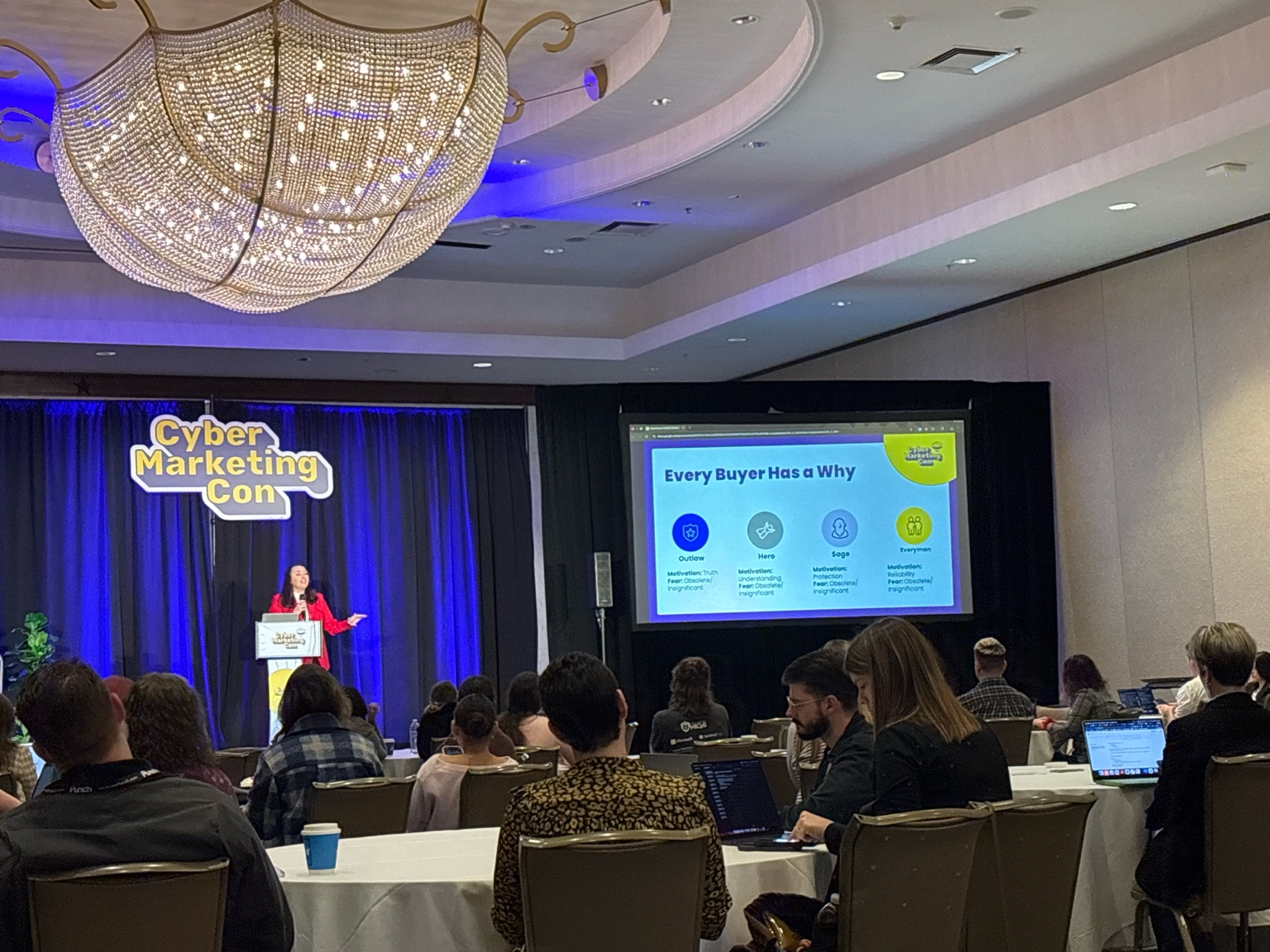
Maril Vernon speaks at CybermarketingCon 2025

It wasn’t creativity; it was a disconnect. It exposed the gap between what was being built and how it was being presented, and why technical audiences instinctively distrust so much marketing content. 

Another perspective on this came up at a CybermarketingCon session by Maril Vernon, cyber evangelist (I hope she will be fine with this title). She spoke about what it really takes to market to practitioners, not just in cyber, but across technical B2B domains. 

She put it bluntly:

“If I’ve never had a reason to trust you, a slick, corporate-looking ad doesn’t tell me ‘We’re professionals.’ It tells me, ‘This was made by Marketing, and Engineering has never seen it.

Technical people are imperfect. We hack at 3 a.m. We’re tired, messy, lazy in the smart way. We write scripts because we don’t want to do the boring thing twice. 

Our work isn’t perfect, and we don’t expect yours to be, either.”

This insight explains exactly why the shoe image had failed. It wasn’t just irrelevant; it signaled distance. It told practitioners this is a marketing act and it was a miss (though the article was a very deep tech one). And this kind of disconnect almost always surfaces first in content, because content is where product reality and market perception collide.

This is precisely where IOD, and where I personally, operate. 

We serve B2B technology vendors through content creation, which by definition puts us in the middle: between engineering and marketing, between product truth and market narrative. Our job is to close that gap. To take real technology, built by real engineers, and turn it into content that technical audiences trust and marketing teams can actually use to drive growth.

That position gives you a unique vantage point. One moment, at AWS re:Invent, you’re deep in a technical review, validating how an algorithm works and where it breaks. Next, you’re at CyberMarketingCon. You’re shaping a story that needs to resonate with practitioners, buyers, and decision-makers. Sitting in the middle, I saw it all, the great friction between tech and marketing.


How to Leverage SMEs for Scalable, High-Impact Tech Marketing Content

Winning the GTM Game: One Brand That’s Nailed It

But there are those B2B tech brands who have mastered this balance. A beautiful example of this in action comes from one of our flagship cases: Wiz. What has stood out to me is the strength and confidence of their go-to-market leadership and how deeply it’s embedded in the company’s operating model. 

During a session by Tom Orbach, he articulated the ability to bring consumer-like thinking into a deeply technical B2B world, without diluting their deep tech product values.

“When you ask AI to explain your idea like you’re a client, or even like you’re five, it strips away all the complexity. You get this wonderfully simple, childlike version that suddenly makes everything click.”

It was really interesting to learn how Orbach brought ELI5 (Explain Like I’m 5) into the serious world of cyber. 

“Marketers often suffer from the curse of knowledge: The more we know, the harder it becomes to explain things simply. Using AI to force an ELI5 explanation strips away unnecessary complexity and surfaces the core idea.” 

What’s powerful is that it doesn’t just clarify, it sparks creativity. That simple explanation often unlocks better storytelling, stronger positioning, and tighter alignment between product and market.

Though I was already familiar with this Wiz approach, I was still struck by how motivated Orbach was and the open-mindedness and creativity of this great brand. This can happen only if your leaders trust and really appreciate their GTM team’s position and value.

Wiz Partners with IOD, Building a Content Engine That Pays for Itself with 18X Organic Traffic

Tech Marketers Deserve So Much More

This alignment problem came up repeatedly in multiple conversations I had with tech marketers at CyberMarketingCon 2025. 

I asked a simple question:
“Do you feel marketing gets enough time, money, and attention from leadership?”

The answers were almost identical:

“We don’t get enough time.”

“Tech doesn’t really understand what we do.”

“The budget is always a fight.”

 “It took years just to get another person on the team.”

Many described being overwhelmed, bombarded with “quick” email requests, while still struggling to secure fair salaries, meaningful equity, or real strategic influence. 

What came through wasn’t complaining. It was frustration rooted in underinvestment.

There’s also a deep misunderstanding around skills that feeds this imbalance. 

I see it often, especially with young tech leaders. These young tech founders build impressive products, reach a point where they want to invest in go-to-market, and then ask a question that always surprises me: 

“Is your writer a native English speaker?”

You must agree with me that this is a ridiculous question; language matters, but it’s not a skill. 

The real expertise lies in understanding technology, markets, positioning, and translating complexity into clarity. 

I am not young, and I see how the tech marketing world has matured significantly, supported by communities such as the cybermarketing community and organizations like G-CMO and numerous others. But that progress only matters if leaders recognize it and invest in the right talent, not whoever is cheapest or closest.

Taking GTM from Theory to Practice

Those two rooms represent how most tech ventures are born. They start in the technical world: builder-heavy, precision-driven, obsessed with what’s possible. Then, often much later, they discover the marketing world, where meaning, narrative, and adoption live. 

The problem isn’t that one side is stronger than the other; it’s that they rarely meet as equals early on. Real success doesn’t come from an 80/20 dynamic in either direction. It comes when technical creation and market understanding share ownership from day one, when the venture is built with both execution and resonance in mind, and the outcome becomes a true 50/50 win.

The conclusion might be uncomfortable, but necessary. 

Tech marketing needs a bigger share of budget, leadership attention, time, and trust. Salaries should be higher. Investment should be higher. The focus should be higher. 

And the corrective preference should take place. Not to overcorrect, but to consciously rebalance a system that has been skewed for years. 

This balance also demands more from tech marketers themselves. They need to be more dominant, respect the strategic weight of their own role, and be strong. This is especially relevant in personal interactions with their company leaders and the R&D team, when pushing back, setting boundaries, and insisting on what the business actually needs in order to grow.

I have served hundreds of B2B tech brands, and I am sure about one thing: When that correction happens, the partnership between product and go-to-market stops being theoretical, and becomes a real competitive advantage.

Is your GTM content built for technical credibility and real impact?

IOD GenAI Labs blends practitioner expertise with performance insights and GenAI-powered scale to grow your brand.

Ofir Nachmani

CEO

A tech evangelist and entrepreneur, Ofir was an early adopter of cloud and spent a decade as a leading cloud blogger—well before it went mainstream. He held executive roles at top tech companies and has served as an independent analyst for AWS, HP, Oracle, Google, and others. With deep roots in both tech and marketing, Ofir founded IOD to bridge the gap between the two—helping vendors build credibility, scale content, and position themselves as industry influencers.

Share with

Uncover real tech &
marketing insights

IOD’s monthly newsletter

Recent Posts

From Gut Feel to Data-Driven: Free Script for GenAI-based Content Creation Evals
IODigest December 2025: GenAI Made Us Stronger, Performance-Driven Content, re:Invent, GTM Lessons, Portfolio Wins, GEO Tips, Happy Holidays
What 70,000 Engineers and 780 Marketers Taught Me About GTM in B2B Tech
AWS re:Invent Days 1 & 2: 5 Key Takeaways